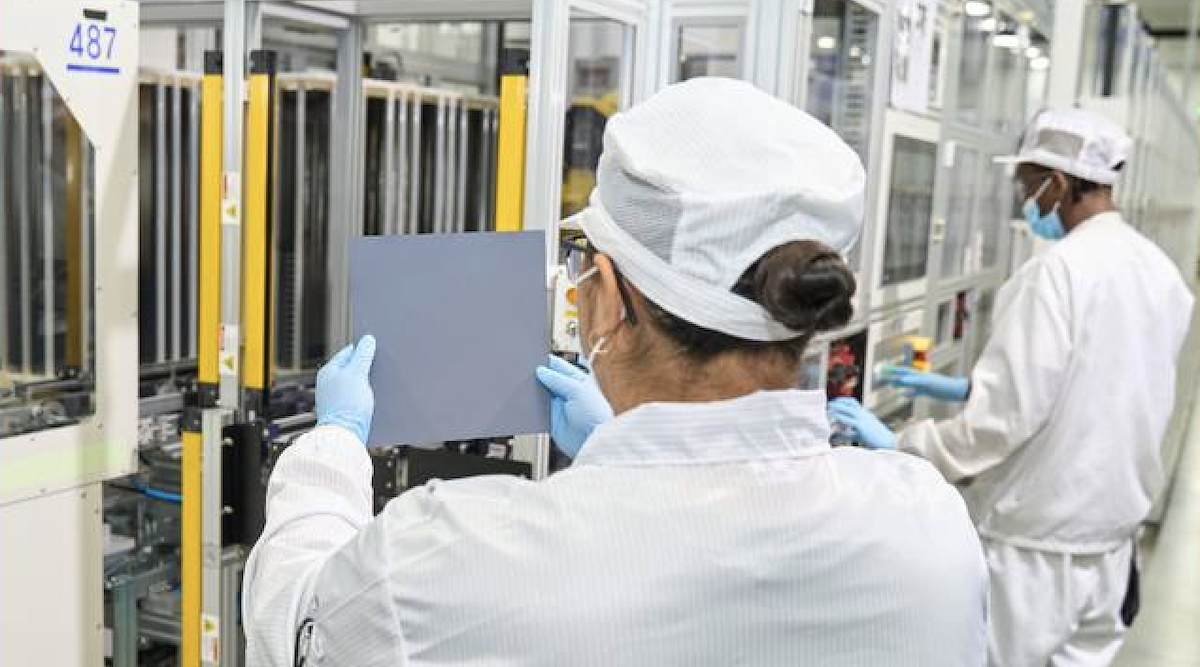
Summary By: eMotoXA new milestone in US solar manufacturing has been reached with the launch of a solar cell fabrication facility in Cartersville, Georgia, operated by the American branch of Korea-based Qcells. This development marks the creation of the country’s first vertically integrated solar factory, capable of producing solar ingots, wafers, and cells all on one site. The Cartersville plant is currently operating at partial capacity, with full production expected by the third quarter of 2026, and alongside Qcells’ expanded Dalton factory, the company aims to achieve a combined annual output of 8.6 gigawatts, equivalent to around 47,000 solar panels per day.
The significance of this facility extends beyond its scale, reflecting a broader resurgence of domestic solar manufacturing in the US. After decades of decline due to international competition, particularly from China, the US solar industry is experiencing a revival supported by government incentives and tax credits designed to encourage domestic content. Qcells’ Cartersville factory is uniquely positioned to benefit from Section 45X tax credits, which apply to every stage of solar panel production, giving the company a competitive edge in the growing renewable energy market. This facility represents the largest ingot and wafer plant ever built in the country, signalling a substantial investment in rebuilding America’s clean energy industrial base.
For solar developers, the emergence of a fully integrated US-based manufacturing hub offers several advantages. Domestic production reduces exposure to supply chain disruptions, tariff uncertainties, and international market volatility, issues that have frequently challenged the solar sector. Additionally, modules produced at Cartersville qualify for a 10% domestic content bonus under current tax legislation, enhancing the financial attractiveness of solar projects. This development comes at a time when utility-scale solar generation has, for the first time, surpassed coal output in the US, a trend likely to accelerate despite federal policy efforts to revive the coal industry.
The broader energy landscape underscores the challenges facing coal power, which continues to decline due to high operational costs, ageing infrastructure, and logistical bottlenecks. Meanwhile, renewable energy sources such as solar and wind remain the most cost-effective and rapidly deployable options to meet growing electricity demand. Despite political resistance, the momentum behind solar power is undeniable, with investments like Qcells’ Cartersville factory demonstrating the sector’s capacity for innovation and growth. This shift not only supports environmental goals but also signals a strategic economic transition towards sustainable energy production in the United States.