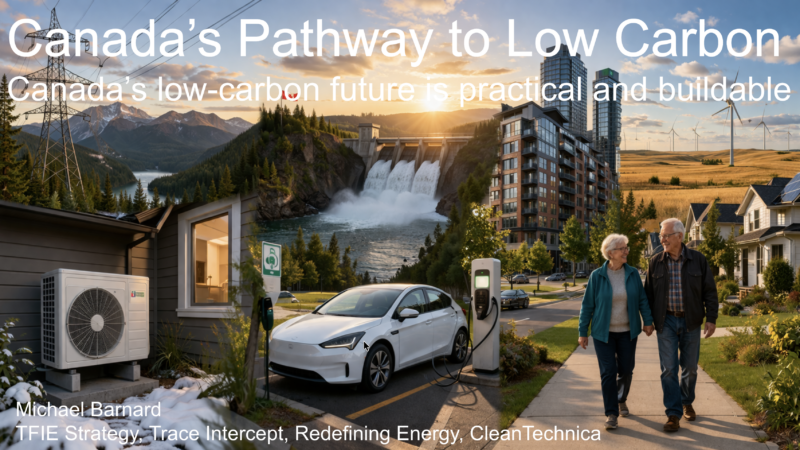
Summary By: eMotoXCanada stands at a pivotal moment in its journey towards decarbonisation, with all the necessary technologies for a clean energy transition already proven and deployable at scale. Michael Barnard, an expert in practical decarbonisation pathways, emphasises that the challenge lies not in technological innovation but in political will, policy frameworks, and effective communication. His recent presentation to a Canadian climate action group highlighted that Canada possesses the core components required to achieve deep emissions reductions, including low-carbon electricity, critical mineral resources, and ample land for renewable energy infrastructure.
Key Canadian provinces such as Quebec, British Columbia, and Manitoba benefit from some of the world’s lowest-carbon electricity grids, largely powered by hydroelectric resources. Ontario’s elimination of coal-fired power plants in the early 2000s stands as a landmark achievement, cutting millions of tonnes of CO2 annually. However, provinces like Alberta and Saskatchewan have seen rising emissions in recent years, offsetting gains made elsewhere. Barnard points out that Canada’s existing rail network and vast land area provide sufficient capacity for large-scale wind, solar, and battery storage projects, underlining that the country’s limitations are more political than physical or technological.
Throughout the discussion, Barnard addressed common questions about controversial or complex topics such as nuclear power, carbon capture and storage, and hydrogen. He advocates for an evidence-based approach that prioritises solutions already proven at scale rather than speculative or unproven technologies. His critique extends to some industry and government claims, particularly around carbon capture, which he argues has failed to deliver meaningful emissions reductions. Barnard’s work encourages citizens, policymakers, and investors to focus on actionable, scalable solutions that can accelerate Canada’s clean energy transition immediately.
The implications of Barnard’s analysis are clear: Canada has the resources and technology to lead in electrification and decarbonisation but must overcome political inertia and policy shortcomings. Accelerating deployment of renewables, expanding transmission infrastructure, and responsibly developing critical minerals could position Canada as a global leader in clean energy. The path forward requires coordinated action and a willingness to implement existing solutions at the necessary scale, rather than waiting for future breakthroughs. Barnard’s insights offer a pragmatic roadmap for how Canada can build the electrified future that is already within its grasp.