Article By:
CleanTechnica
2026-06-08 16:56:39
Steel Needs A Route Transition, Not A Hydrogen Story
Summary By: eMotoX
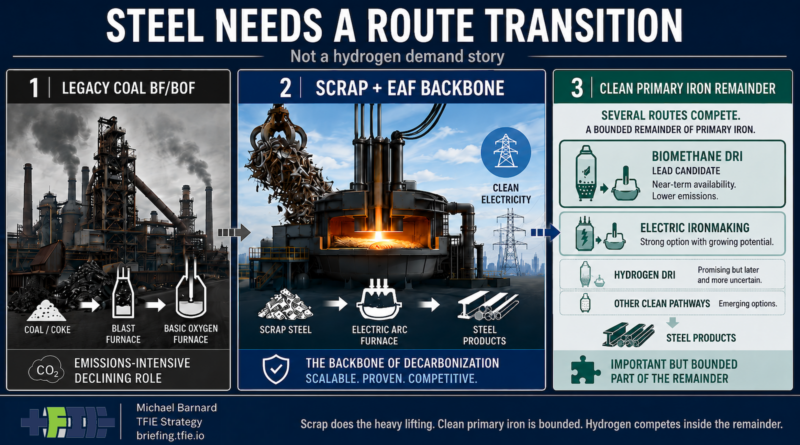
Steel decarbonisation should be understood primarily as a shift in production routes rather than a straightforward hydrogen demand story. The sector’s transition hinges on the increasing use of scrap steel processed through electric arc furnaces (EAFs), which already form a significant part of global steelmaking where infrastructure and product requirements align. While clean primary iron production remains essential, it constitutes a bounded and contested market segment, with hydrogen-based direct reduced iron (DRI) being just one of several emerging technologies. The legacy coal-dependent blast furnace and basic oxygen furnace methods must be phased out to meet climate targets, underscoring the need for a strategic focus on route transitions rather than hydrogen infrastructure expansion alone.
The scale of the challenge is considerable, with global crude steel production projected at nearly 1.9 billion tonnes in 2024 and associated emissions averaging over two tonnes of CO₂ equivalent per tonne of steel. Steel is a major industrial emitter, making its decarbonisation critical to broader climate goals. Unlike fuels, steel accumulates in long-lived assets such as buildings and infrastructure before returning as scrap, which emphasises the importance of managing the stock-and-flow dynamics of steel materials. This perspective shifts the conversation away from hypothetical hydrogen demand towards practical questions about scrap availability, clean primary iron production, and the feasibility of different decarbonisation routes under real-world constraints.
Hydrogen’s role in steelmaking, while significant in some direct reduction processes, is not a universal solution. It must compete with alternative technologies and approaches, including electrification and the import of green iron from regions with favourable resources and infrastructure. The European experience illustrates the complexity of industrial policy in this sector, where green steel production—encompassing alloying, finishing, and product quality—may be more critical than simply producing green iron domestically. Policymakers and investors should prioritise credible transition pathways that address existing capital stock, access to clean electricity, and realistic scrap management, rather than focusing narrowly on hydrogen targets or announcements.
The transition away from coal-based blast furnaces poses a significant capital challenge, as these assets are deeply embedded in industrial, financial, and political ecosystems. Decisions to maintain or retire such facilities involve balancing short-term financial considerations against long-term climate imperatives. This tension highlights the need for nuanced strategies that reconcile industrial realities with decarbonisation goals. For hydrogen developers, the takeaway is that while there is potential demand within certain steelmaking routes, the market is smaller and more contested than often portrayed, requiring targeted and pragmatic engagement rather than broad assumptions about hydrogen’s role in steel’s future.