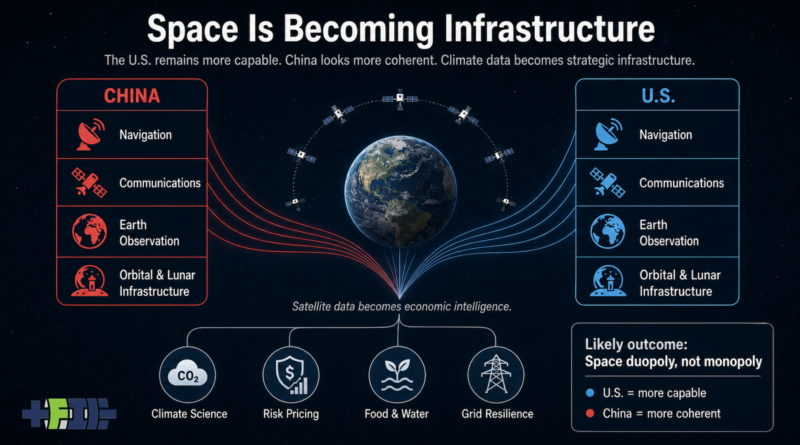
Summary By: eMotoXChina is rapidly transforming its space programme into a comprehensive national infrastructure, challenging long-held Western assumptions about its capabilities. Rather than focusing on singular technological feats or headline-grabbing missions, China is methodically building sovereign and scalable systems across multiple strategic layers of space activity. Its achievements, such as the BeiDou navigation system, Tiangong space station, and various satellite constellations, are designed not merely to compete with Western counterparts but to establish independence from US-controlled space assets in navigation, communication, and Earth observation.
The Chinese approach extends beyond Earth orbit, with lunar and Martian exploration programmes marking significant milestones. The Chang’e lunar missions, including the first far-side sample return, and the Tianwen Mars mission, which combines orbiting, landing, and rover operations, position China firmly among the leading spacefaring nations. These efforts are part of a broader, interconnected system where each element supports others, from launch capabilities enabling satellite constellations to Earth observation satellites aiding disaster management and geopolitical influence. This integrated strategy reflects China’s framing of space as a critical component of its national strategy, supported by a rapid increase in launch activity and ambitious plans for the coming years.
Despite China’s progress, the United States maintains a technological and institutional edge, largely due to the innovative impact of SpaceX and the depth of NASA’s scientific infrastructure. SpaceX’s Falcon 9 and Starlink projects have revolutionised launch economics and satellite communications, while the upcoming Starship vehicle promises to further transform heavy launch and space logistics if it overcomes significant technical challenges. However, the US space sector faces considerable risks, including budgetary uncertainties, political interference, and a heavy reliance on a single private company controlled by Elon Musk, which could jeopardise continuity and resilience in national space capabilities.
The concentration of critical space functions within SpaceX presents both opportunities and vulnerabilities. While the company’s achievements have been pivotal for US space leadership, dependence on one organisation and one founder raises concerns about governance, accountability, and the potential for systemic failure. Experts argue that the solution lies not in penalising SpaceX but in fostering redundancy and diversification within the US space ecosystem to ensure national security and strategic autonomy. This balanced approach aims to support innovation while mitigating risks associated with overreliance on a single commercial entity.
Looking ahead, the evolving space race underscores the importance of sustained investment, strategic planning, and international competition in space infrastructure. China’s steady, system-wide buildout of space capabilities signals a shift towards a more multipolar space environment where dominance is measured by operational sovereignty and integrated capacity rather than headline achievements alone. Meanwhile, the US must navigate the dual challenge of harnessing private sector innovation while maintaining robust, government-led programmes to secure its position in the increasingly contested domain of space.