EV news article header featuring electric vehicle news, EV charging station, electric car updates and industry insights

News Menu

bicycle news feed and industry updates for eBike and cycling news
Click for Bicycle News
latest eBike news aggregator covering electric bike updates, reviews and industry trends
Click for eBike News
electric motocross news feed with latest dirt bike updates, reviews and industry insights
Click for eMotocross News
latest eScooter news aggregator featuring electric scooter news feed, updates, reviews and industry trends
Click for eScooter news
Article By:
CleanTechnica
2026-05-19 22:18:04

Poland Bought Hydrogen Buses. Then The Fuel Bills Arrived

Summary By: eMotoX
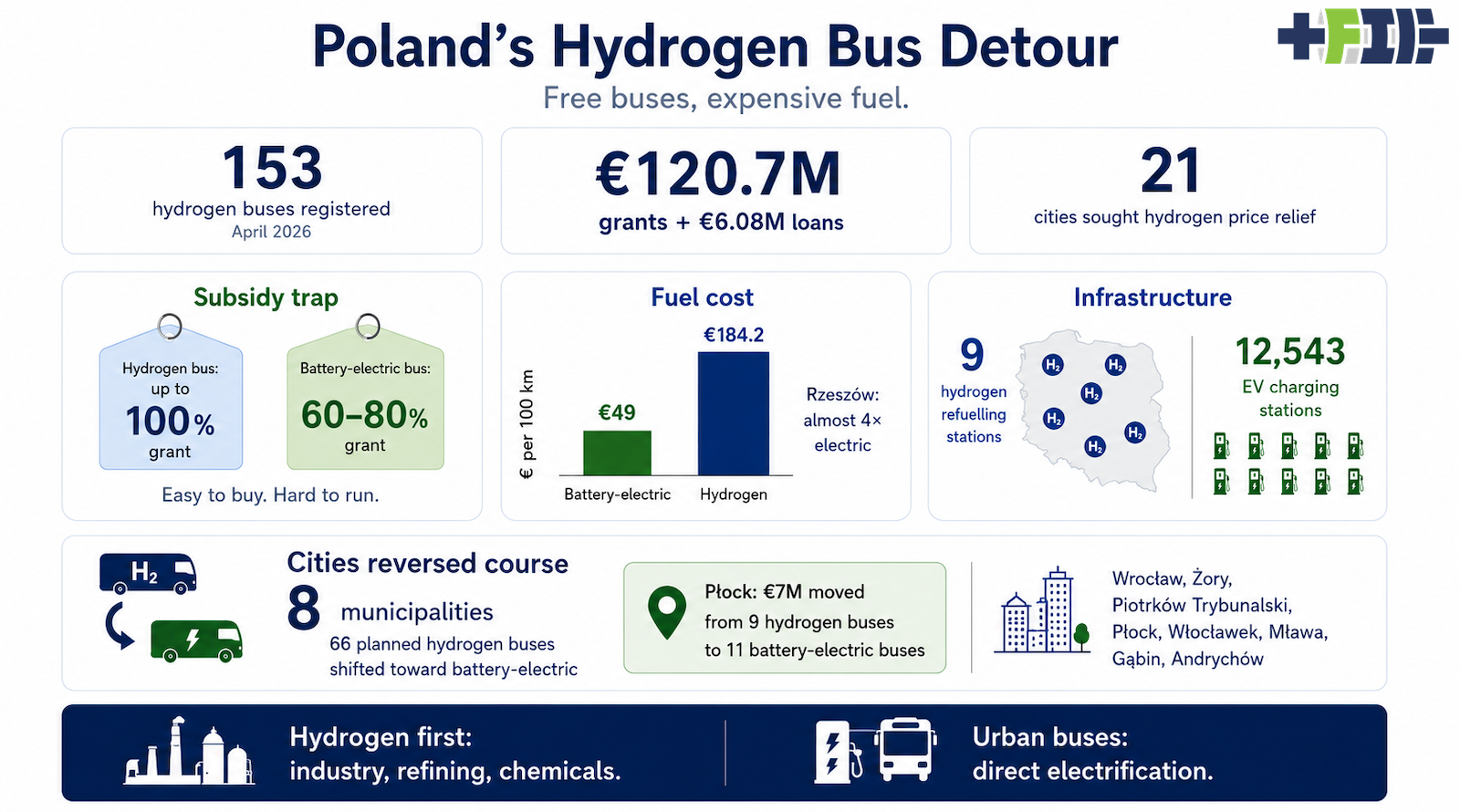
Poland’s ambitious investment in hydrogen buses has encountered significant challenges as operational fuel costs have emerged as a major obstacle. By April 2026, the country had deployed 140 hydrogen buses in service across 12 cities, with over 100 more contracted, marking a substantial commitment beyond pilot projects. This rollout was part of a broader national strategy aimed at fostering a domestic hydrogen economy, with targets set for hundreds of buses and supporting infrastructure by 2030. However, the practical realities of running these buses have exposed the limitations of the approach, particularly in comparison to battery-electric alternatives that have been gaining traction across Europe. The core issue lies in the economic and operational viability of hydrogen as a fuel for public transport. While Poland’s hydrogen bus purchases were heavily subsidised—often covering the entire capital cost—cities have struggled with the high and volatile price of hydrogen fuel. Reports indicate that hydrogen refuelling costs can be several times higher than electricity for battery buses and even significantly more expensive than diesel in some cases. These soaring fuel bills have forced municipalities to seek additional government support to cover operating expenses, revealing a disconnect between initial procurement subsidies and ongoing running costs. Poland’s hydrogen bus programme was driven by industrial policy ambitions rather than purely transport or environmental objectives. The government envisioned buses as a catalyst for creating demand that would justify investment in hydrogen refuelling stations and production capacity, thereby establishing a national hydrogen industry. However, this approach overlooked the fundamental purpose of public buses—to provide reliable, affordable, and low-emission transport. Battery-electric buses, which require less complex infrastructure and use electricity directly, have proven to be a more cost-effective and lower-risk option for most urban routes, raising questions about the strategic rationale behind Poland’s hydrogen focus. The financial implications of the hydrogen bus strategy are considerable. Over €120 million in grants and loans have been allocated to support hydrogen buses and refuelling stations, yet the high operational costs threaten the sustainability of these investments. Cities like Chełm and Wałbrzych have formally requested government assistance to bridge the gap between hydrogen and conventional fuel prices, highlighting the growing fiscal pressure on municipal budgets. This situation underscores the risks of adopting emerging technologies without fully accounting for total lifecycle costs and market readiness. Looking ahead, Poland’s experience serves as a cautionary tale for other regions considering hydrogen for public transport. While hydrogen has potential in specific niches, the current evidence suggests that battery-electric buses remain the most practical zero-emission solution for urban fleets. Policymakers may need to reassess support frameworks to prioritise technologies that deliver emissions reductions at lower cost and operational risk. The challenge will be balancing industrial ambitions with the imperative to provide efficient and affordable public transport services.