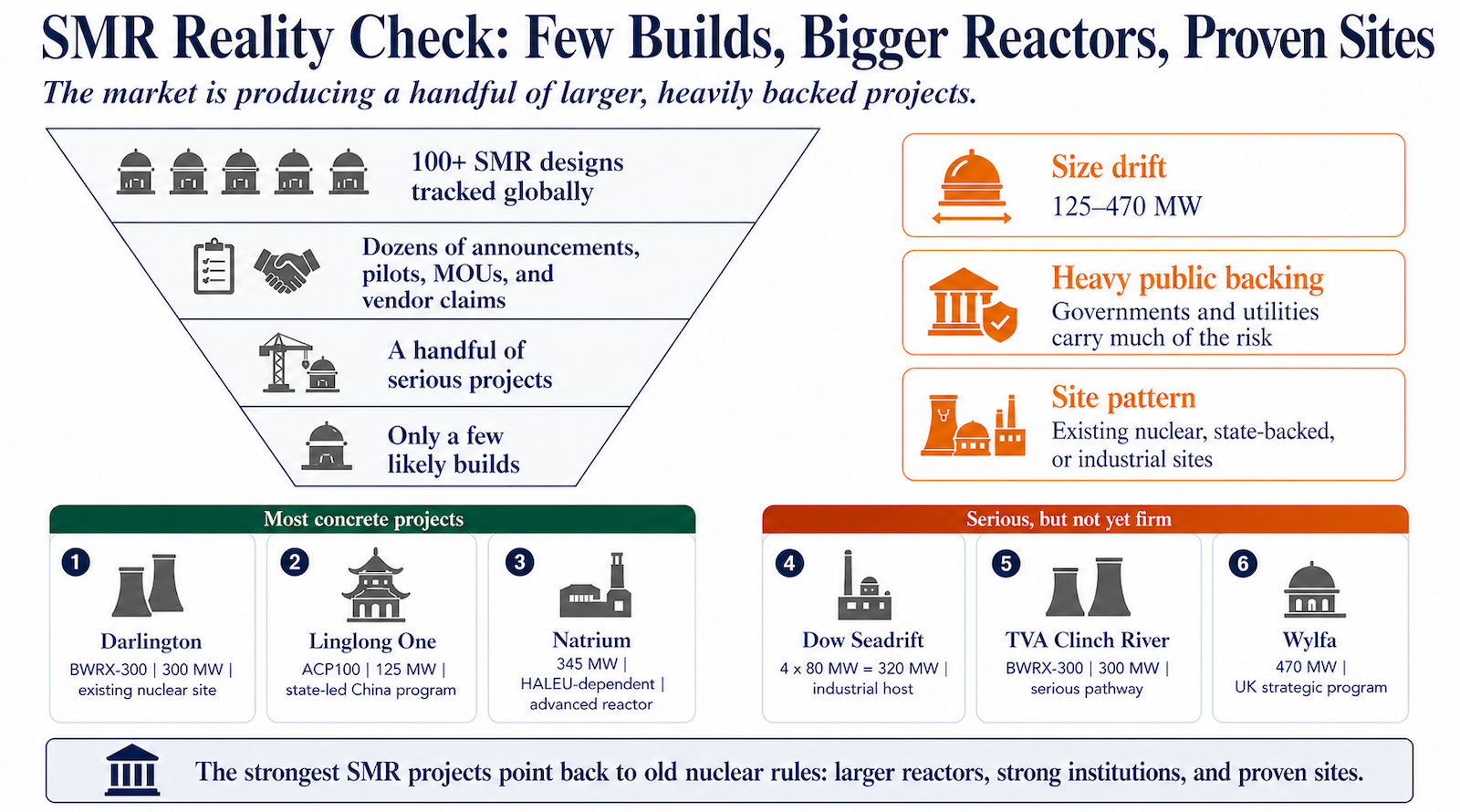
Summary By: eMotoXSmall modular reactors (SMRs) have been promoted as a solution to the challenges facing nuclear power, promising smaller, factory-built units that could be deployed more rapidly and flexibly than traditional large reactors. However, the reality of SMR development reveals significant obstacles to this vision. Despite the initial appeal of reducing capital risk and construction times, the sector has become increasingly fragmented, with over 120 designs worldwide and no clear frontrunner. This proliferation undermines the economies of scale and learning curves essential for cost reduction and reliable mass production, which have driven success in other low-carbon technologies like solar and wind.
The complexity of nuclear technology means that each SMR design requires extensive and distinct regulatory, safety, and operational frameworks. Unlike software or consumer electronics, nuclear reactors cannot be rapidly iterated or easily standardised due to stringent licensing, fuel qualification, and long-term liability considerations. The diversity of reactor types—from light-water to molten salt and sodium-cooled designs—adds layers of technical and logistical challenges. This fragmentation contrasts sharply with historical nuclear scaling, which depended on a few standardised designs supported by strong state institutions and stable supply chains.
Recent analyses, including a U.S. Energy Information Administration (EIA) report, highlight the broad range of SMR applications and ongoing research but stop short of addressing the critical questions about scalability and industrial viability. The report outlines potential uses in remote locations, data centres, and military sites, supported by government programmes and pilot projects. However, it does not tackle whether the current order books can sustain factory learning, whether markets are large enough to justify manufacturing capacity, or whether advanced fuel supply chains will be ready in time. This leaves the SMR sector in a state of exploratory activity rather than clear commercial deployment.
Historical nuclear power expansion succeeded where governments played a central role in aligning utilities, regulators, vendors, and finance around standardised reactor designs. Countries like France, South Korea, and China scaled nuclear power through long-term strategic programmes and institutional coherence. SMRs were initially pitched as a way to bypass these conditions, but emerging projects suggest a return to the traditional model. The most credible SMR developments are linked to existing nuclear sites, state-backed initiatives, and experienced operators, reaffirming that strong institutional frameworks remain crucial for nuclear success.
While SMRs hold potential for niche applications and incremental innovation, their current trajectory challenges the notion that they will revolutionise nuclear power through mass manufacturing and widespread deployment. Instead, the sector appears to be validating longstanding lessons about the need for disciplined policy, design convergence, and institutional support. The future of SMRs likely depends on reconciling these realities with the original promises, rather than expecting them to deliver rapid, large-scale disruption in the energy landscape.