Article By:
CleanTechnica
2026-05-05 14:47:31
Not Just Cars: Watch The Robotic Shift At Auto China 2026
Summary By: eMotoX
The Beijing International Automotive Exhibition, Auto China 2026, marked a significant evolution in China’s automotive industry, showcasing a shift from purely electrified and software-driven vehicles towards what is termed Physical AI. This concept extends artificial intelligence beyond cars into robots and other machines capable of interacting with the physical world. Rather than viewing vehicles as isolated innovations, manufacturers are now developing shared AI platforms that power a range of devices, from humanoid robots to autonomous factory systems, signalling a broader ecosystem of intelligent machines.
XPeng exemplifies this trend with its humanoid robot Iron, which utilises the same AI architecture as its advanced driver-assistance systems. Standing at 178 cm and equipped with automotive-grade sensors like LiDAR and cameras, Iron demonstrates how mobility AI can be adapted for robotics, enabling it to navigate indoor environments and interact with humans. XPeng’s approach highlights the convergence of automotive and robotics technologies, with early deployments aimed at controlled service settings where safety and human interaction are paramount.
Meanwhile, Xiaomi is taking a pragmatic approach by integrating humanoid robots into its electric vehicle manufacturing processes. Robots in Xiaomi’s Beijing factory have been tested on repetitive tasks such as fastening in a die-casting workshop, achieving a success rate above 90% under real production conditions. These robots are powered by advanced multimodal AI models that improve through reinforcement learning, and Xiaomi plans to expand their capabilities to more complex tasks like bin-picking, which have traditionally challenged industrial automation.
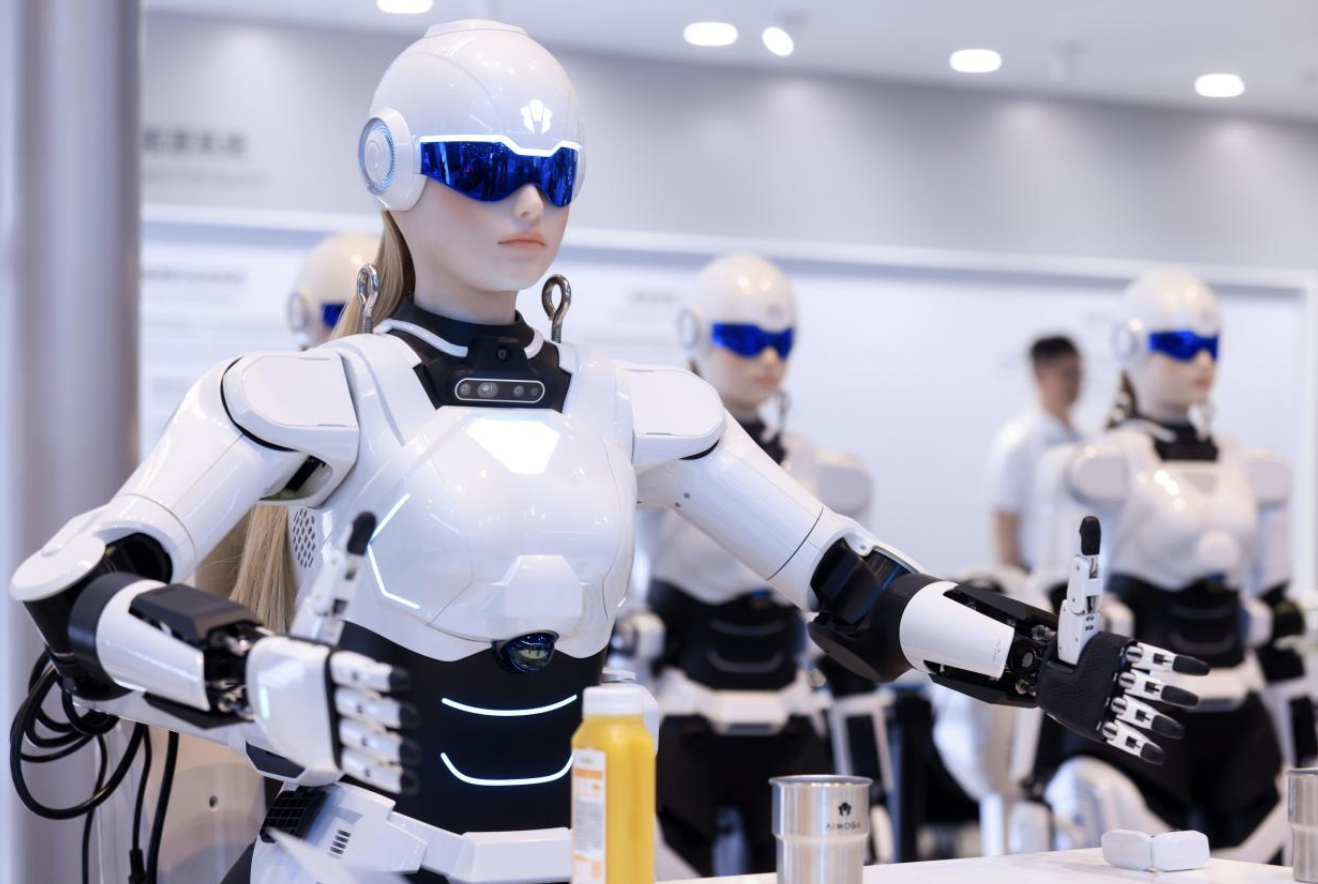
Chery is pursuing a commercial and consumer-facing strategy through its AiMOGA division, presenting a range of robots including humanoids, quadrupeds, and service models for public safety at Auto China 2026. Notably, Chery aims to scale robotics sales via its existing automotive dealership network, pricing its humanoid robot competitively to test mass-market adoption. Early use cases focus on retail interaction and customer assistance, emphasising predictable behaviour and branding alongside technical performance.
Other industry players such as UBTECH Robotics and Geely are pushing the boundaries of humanoid deployment and autonomous mobility. UBTECH’s Walker S2 robots support logistics and assembly in factories but currently operate at about half the efficiency of human workers, with improvements expected in the coming years. Geely’s purpose-built robotaxi platform represents a new class of fully driverless vehicles designed from the ground up as mobile robots, relying on integrated perception and planning systems rather than retrofitted controls. Collectively, these developments illustrate a future where AI underpins a diverse range of physical forms, blending electric mobility with embodied intelligence across China’s automotive and robotics sectors.