Article By:
Charged EVs
2026-05-20 15:22:17
MathWorks adds Renesas hardware support packages for direct Simulink deployment to automotive and industrial MCUs
Summary By: eMotoX
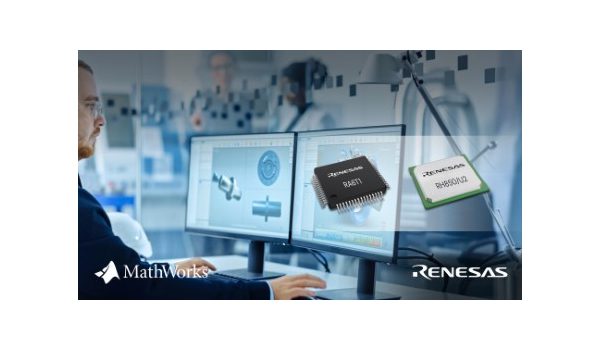
MathWorks has introduced new hardware support packages for Renesas microcontrollers, enabling direct deployment of MATLAB and Simulink models onto automotive and industrial MCUs. These packages support the RH850/U2A automotive microcontroller and the RA6T2 industrial microcontroller, allowing engineers to bypass manual toolchain assembly, initialization code writing, and custom flash scripting. This development streamlines the process of moving control algorithms from simulation directly to physical hardware, significantly reducing the complexity and time involved in integration.
The RH850/U2A microcontroller is widely utilised in automotive electronic control units (ECUs), particularly for electric vehicle traction motor control, advanced driver-assistance systems (ADAS), and body electronics. The new support package facilitates the deployment of critical algorithms such as field-oriented control and regenerative braking, enabling faster transitions from design and simulation phases to hardware validation and vehicle-level testing. This enhancement promises to accelerate calibration processes across various drive cycles, improving overall development efficiency for automotive engineers.
On the industrial side, the RA6T2 package targets motion control applications, including servo drives and variable-speed drives used in robotics and factory automation. The one-click deployment feature supports on-bench closed-loop tuning, allowing engineers to simulate, validate, and adjust their designs with greater speed and precision. This integration reduces the need for extensive manual configuration, fostering quicker iteration cycles and more efficient system optimisation.
Brad Rex, Senior Director at Renesas, highlighted the benefits of the collaboration with MathWorks, emphasising the elimination of manual toolchain and driver assembly. This partnership enables development teams to simulate and validate designs earlier in the process, accelerating iteration and reducing integration overhead. The move represents a significant step towards simplifying embedded system development workflows in both automotive and industrial sectors.
The new hardware support packages reflect ongoing efforts to bridge the gap between simulation environments and real-world hardware deployment, ultimately shortening development timelines and enhancing product reliability. As electric and automated systems continue to evolve, such tools will be crucial in supporting rapid innovation and ensuring robust performance in increasingly complex applications.