Article By:
CleanTechnica
2026-05-20 06:31:26
Hydrostor’s Underground Pumped Hydro Ontario Storage Plan Runs Into the BESS Benchmark
Summary By: eMotoX
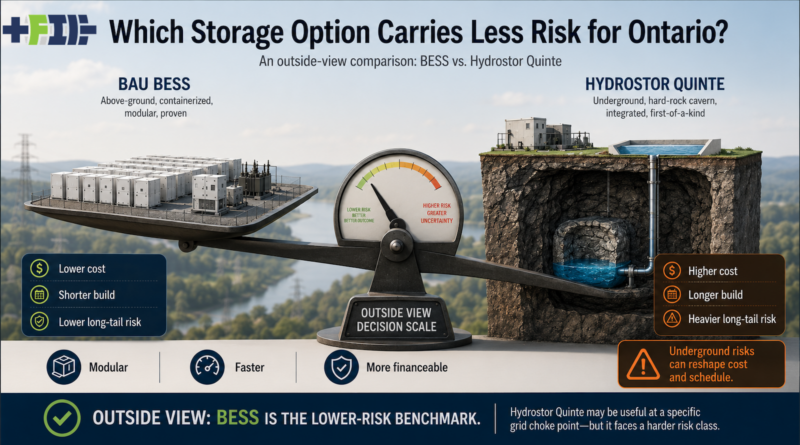
Hydrostor’s proposal for the Quinte Energy Storage Centre in eastern Ontario represents an ambitious attempt to address local grid constraints through an innovative underground pumped hydro system. This project targets a specific transmission bottleneck near the Napanee and Lennox transformer stations, where dispatchable capacity and grid flexibility are in high demand. Unlike traditional pumped hydro, which requires two reservoirs at different elevations and significant land and water resources, Hydrostor’s advanced compressed air energy storage (A-CAES) technology utilises hard-rock caverns and water displacement to generate and stabilise pressure, aiming to deliver 500 MW of power for eight hours, or 4 GWh of energy storage.
Hydrostor’s system differs substantially from conventional compressed air storage by capturing and reusing compression heat and employing water as a critical component to maintain pressure stability during discharge. This water column, located hundreds of metres underground, acts similarly to a hydraulic piston, ensuring a steady pressure output that enhances the quality and reliability of electricity generation. While the physics underpinning the technology are sound, the engineering challenge lies in scaling this concept from the company’s smaller Goderich demonstration plant, which is around 1.75 MW, to the much larger Quinte facility. The leap to 500 MW and 4 GWh storage capacity represents a significant step up in complexity and risk.
The Quinte project is being positioned for Ontario’s Independent Electricity System Operator (IESO) Long Lead-Time Request for Proposals (RFP), which targets resources requiring over five years of development and offers up to 40-year contracts. Such long-term agreements are crucial for securing investment in high-capital infrastructure projects but also carry the risk of locking ratepayers into potentially unfavourable cost and performance outcomes. The project’s success will depend not only on technological execution but also on its ability to deliver value at a critical grid location where traditional pumped hydro is unfeasible due to geographic and environmental constraints.
Hydrostor’s approach highlights the importance of locational value in energy storage, emphasising that capacity placed at transmission choke points can provide greater grid benefits than storage sited in less constrained areas. However, the scale and novelty of the Quinte facility mean it will face rigorous scrutiny, especially when compared to large-scale battery energy storage systems (BESS) that have become the benchmark for long-duration storage. The project raises important questions about the future mix of storage technologies in Ontario, balancing innovation against proven battery solutions, and the need for flexible, reliable capacity to support the province’s evolving energy grid.