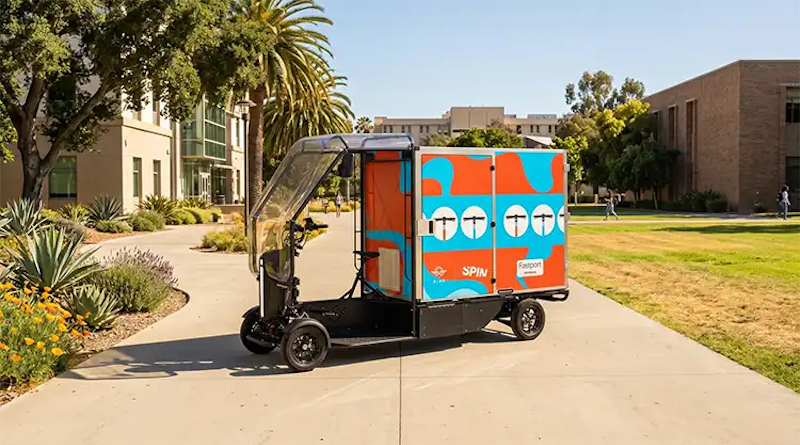
Summary By: eMotoXHonda is intensifying its efforts to increase electric vehicle (EV) sales in the US through its Fastport venture, despite recent setbacks in its broader vehicle electrification strategy. The company has partnered with Third Lane Mobility, a leading micromobility firm, to introduce the eQuad, a compact four-wheeled electric cargo bike designed for urban environments. The eQuad is tailored to fit within standard bike lanes, targeting congested city areas as well as campuses and other controlled settings, aiming to capitalise on the growing micromobility and urban delivery markets.
The eQuad has received acclaim for its innovative design, winning the 2025 Red Dot “Best of the Best” award. Its dimensions and exposed mechanical elements allow it to integrate seamlessly into the bicycle ecosystem, retaining familiar bike components like pedals and handlebars to appeal to a broad range of cyclists. However, the rise of such vehicles also raises concerns about bike lane congestion and safety, as urban bike lanes are increasingly crowded with various types of e-bikes, delivery vehicles, and pedestrians, complicating the original intent of providing safe spaces for cyclists.
Honda’s collaboration with Third Lane Mobility extends to micromobility operators Bird and Spin, which will use the eQuad to support their fleet operations, including battery swapping and vehicle rebalancing. This partnership underscores Honda’s broader strategy to embed the eQuad within existing urban mobility infrastructures, targeting diverse applications such as parcel delivery, food service, municipal use, and campus logistics. Fastport’s Fleet-as-a-Service platform complements the vehicle with features like real-time fleet utilisation data, preventative maintenance scheduling, and integrated telematics, enhancing operational efficiency.
A particularly notable aspect of the eQuad is its use of swappable lithium-ion batteries, a feature that has struggled to gain traction in the US market for larger EVs but is more common among smaller electric vehicles. Fastport’s adoption of Honda’s Mobile Power Pack batteries, which are lightweight and designed for easy manual swapping, could help address issues of downtime and charging infrastructure limitations. This approach aligns with emerging trends in public battery swapping stations, which aim to improve safety and convenience for micromobility users.
Looking ahead, Honda plans to expand the deployment of the eQuad and its associated services across multiple US locations, signalling a commitment to growing its footprint in the micromobility sector. While regulatory and infrastructural challenges remain, particularly regarding bike lane usage and urban space allocation, Honda’s persistence in this niche market reflects a broader shift towards diversified electric mobility solutions beyond traditional passenger vehicles. The success of Fastport’s initiatives could influence future urban transport policies and the evolution of last-mile delivery systems.