Summary By: eMotoXA recent study by Transport & Environment (T&E) highlights the significant risks facing electric vehicle (EV) investment across Europe amid ongoing debates over the European Union’s car CO2 emissions targets for 2030 and 2035. The EU’s current regulatory framework, which sets ambitious emissions reductions, has driven substantial investment in battery electric vehicle (BEV) production, battery manufacturing, and associated supply chains. However, proposed revisions to these targets—particularly those favoured by the automotive industry—threaten to drastically reduce the scale of the European EV market, potentially undermining the continent’s ability to compete in the global transition to clean transport.
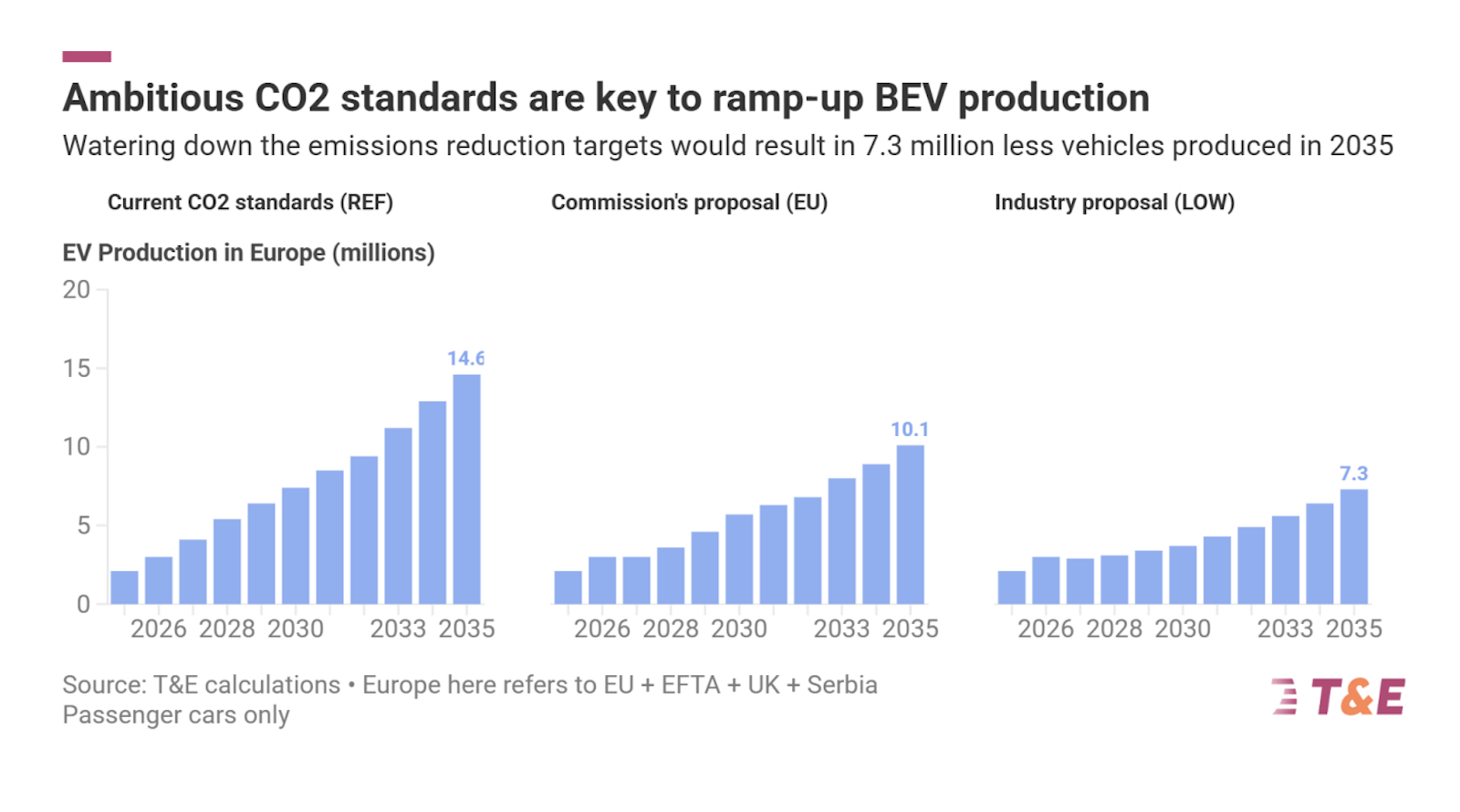
The report outlines three scenarios to assess the industrial opportunity costs of weakening CO2 targets: maintaining current regulations (REF), the European Commission’s proposed relaxation (EU), and the more lenient automotive industry position (LOW). Under the industry’s preferred scenario, BEV production in Europe could halve by 2030, dropping from an expected 7.4 million vehicles to just 3.7 million. This contraction would also significantly impact battery manufacturing capacity, with over 34 Northvolt-sized factories potentially not being built, resulting in the loss of up to 47,000 jobs. Even the Commission’s proposal, which is less severe than the industry’s, would reduce BEV production by nearly a quarter and cut battery plant capacity by more than half.
The consequences extend beyond vehicle production to the entire battery value chain, including critical components like cathodes. Strong CO2 targets and supportive industrial policies could enable Europe to meet over two-thirds of its cathode demand domestically by 2030. In contrast, the industry’s weaker targets would see only a fraction of this capacity realised, with just five projects likely to proceed and covering barely 10% of demand. Moreover, the report warns that relaxing emissions targets could lead to a €50 billion waste on oil imports by 2035, as the continent misses out on the opportunity to reduce oil dependency through electrification. Battery materials, by comparison, represent a far smaller dependency risk and can be sourced and recycled within Europe if industrial policies are properly implemented.
To safeguard Europe’s EV industrial base and ensure the continent remains a global leader in clean automotive technology, the report urges the EU to maintain its current 2030 and 2035 CO2 targets without dilution. It also calls for robust local content requirements within the proposed Industrial Accelerator Act (IAA) to prevent loopholes, such as allowing vehicles with non-European batteries to qualify as ‘Made in EU’. These measures are deemed essential to provide investment certainty, support domestic manufacturing, and secure jobs in the fast-growing EV sector. Without decisive action, Europe risks strategic industrial decline just as the global automotive market pivots decisively towards electrification.