EV news article header featuring electric vehicle news, EV charging station, electric car updates and industry insights

News Menu

bicycle news feed and industry updates for eBike and cycling news
Click for Bicycle News
latest eBike news aggregator covering electric bike updates, reviews and industry trends
Click for eBike News
electric motocross news feed with latest dirt bike updates, reviews and industry insights
Click for eMotocross News
latest eScooter news aggregator featuring electric scooter news feed, updates, reviews and industry trends
Click for eScooter news
Article By:
Charged EVs
2026-05-15 15:49:59

Hanyang University pins minimum LNO coating at 2.5 nm for sulfide solid-state battery cathodes

Summary By: eMotoX
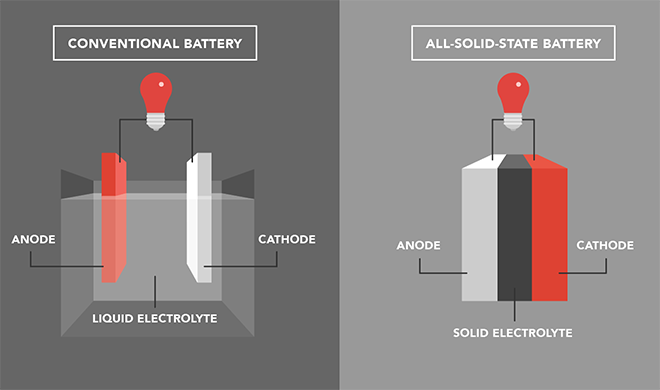
Researchers at Hanyang University have established a critical benchmark for the protection of cathode materials in sulfide-based all-solid-state batteries (ASSBs). Their study identifies 2.5 nanometres as the minimum effective thickness for lithium niobium oxide (LNO) coatings applied to NCM811 cathode powders, a key advance in mitigating the chemical reactivity issues at the cathode–electrolyte interface. This finding addresses a significant gap in the field, where the optimal coating thickness to prevent degradation had not been quantitatively defined. The team employed rotary powder atomic layer deposition (ALD) to apply LNO coatings at three different thicknesses: 1.0 nm, 2.5 nm, and 5.0 nm. Their results revealed a delicate balance between initial capacity and long-term stability. While the thinnest coating of 1.0 nm yielded the highest initial discharge capacity, it suffered from a 28% shorter cycle life and significantly higher interfacial resistance compared to the 2.5 nm coating. Spectroscopic analysis confirmed that the 1.0 nm layer was insufficient to fully suppress detrimental side reactions, whereas the 2.5 nm coating effectively acted as a diffusion barrier, extending cycle life by 43% and halving interfacial resistance relative to uncoated cells. Professor Tae Joo Park, who led the research, emphasised the practical implications of these findings, stating that the 2.5 nm thickness provides a clear guideline for optimising the cathode–electrolyte interface in next-generation solid-state batteries. The study highlights the potential of powder ALD techniques for scalable manufacturing, although integrating this process into gigafactory production lines remains a challenge. The research offers valuable insights for improving the durability and performance of sulfide-based ASSBs, a crucial step towards their commercial viability. Published in the journal Energy Storage Materials, this work not only advances fundamental understanding but also sets a benchmark for future development of protective coatings in solid-state battery technology. As the industry seeks to enhance battery longevity and safety, such precise engineering of interface layers could play a pivotal role in accelerating the adoption of solid-state batteries in electric vehicles and other applications.