Article By:
Charged EVs
2026-05-19 16:47:29
Ford rotor built with 100% recycled rare earth magnets passes durability test
Summary By: eMotoX
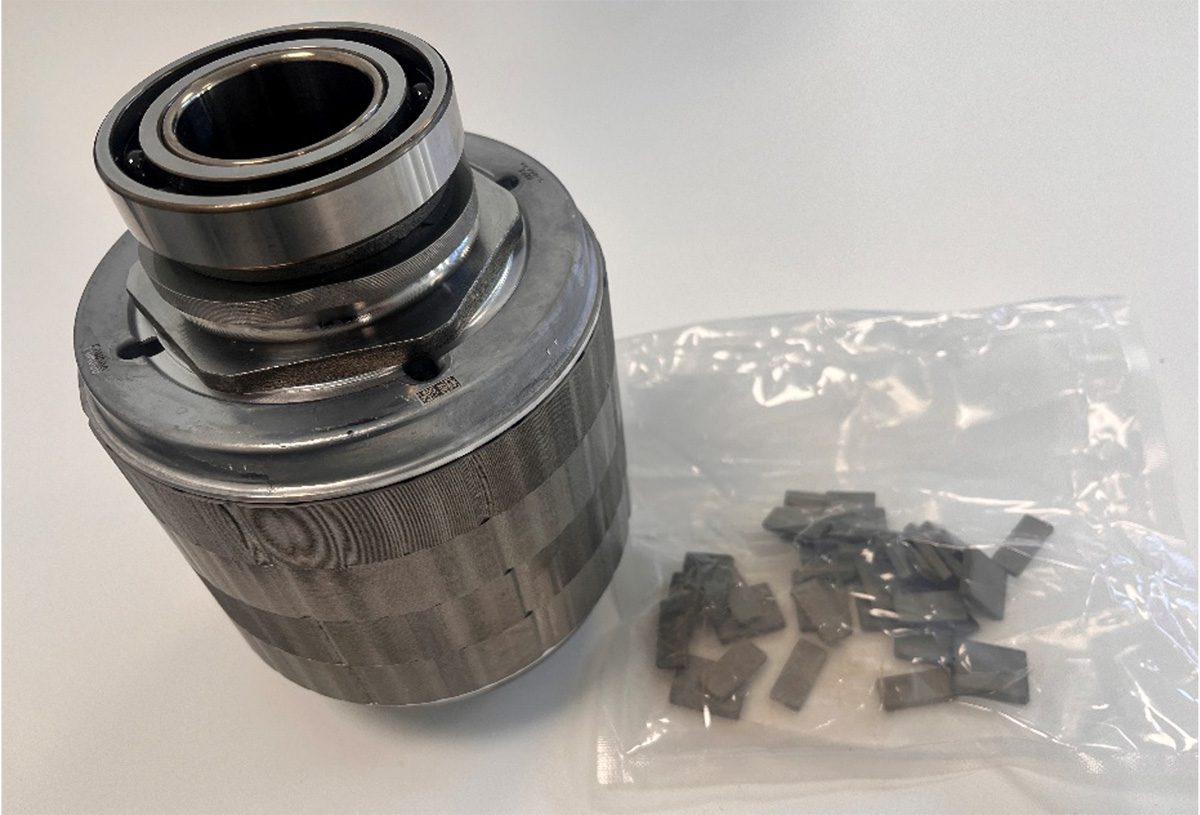
A UK-based consortium has successfully demonstrated a fully circular supply chain for rare earth magnets used in electric vehicle (EV) motors, culminating in Ford validating the performance of a rotor built entirely from recycled materials. The process began with Ionic Technologies in Belfast recycling scrap neodymium-iron-boron (NdFeB) magnets into rare earth oxides, which were then converted into metal alloys by Less Common Metals (LCM). GKN subsequently manufactured finished magnets in Germany, which Ford assembled into test rotors at its Halewood plant. One of these rotors underwent rigorous durability testing at Ford’s Dunton R&D facility, achieving results on par with rotors made from conventional, mined rare earth materials.
The purity of the recycled rare earth oxides was notably high, with neodymium oxide reaching 99.87%, dysprosium oxide 99.56%, and terbium oxide 99.75%, all derived from 100% recycled feedstock. The batch sizes produced exceeded the minimum requirements for manufacturing, and GKN reported that the recycled alloy flakes performed identically to virgin material during magnet production. This breakthrough is particularly significant given recent Chinese export restrictions on rare earth elements, which have heightened concerns over supply chain security in Western automotive manufacturing. Dysprosium and terbium, critical for maintaining magnet performance at high temperatures in EV motors, were among the recycled elements successfully reclaimed.
Ford’s UK Innovation Manager, Dennis Witt, emphasised the importance of this achievement, highlighting that the recycled magnets met the company’s stringent commercial standards on the first attempt. The project received funding through the UK Government’s CLIMATES initiative, supported by the Department for Business and Trade and InnovateUK. While the current work represents a proof of concept rather than mass production, Ionic Technologies is progressing towards a commercial-scale plant in Belfast, with an anticipated annual capacity of 400 metric tonnes of rare earth oxides. The facility has received an initial offer for a £12 million government capital grant as part of an £85 million investment plan.
Looking ahead, the consortium is advancing a follow-up project called CirculaREEconomy, funded by the Advanced Propulsion Centre UK’s DRIVE35 programme, which aims to further develop and scale the circular rare earth supply chain. This initiative underscores the growing focus on sustainable and secure sourcing of critical materials for the rapidly expanding EV market. The success of this collaboration could pave the way for reduced reliance on mined rare earths and enhance the resilience of the UK’s electric vehicle supply chain in the face of geopolitical challenges.