EV news article header featuring electric vehicle news, EV charging station, electric car updates and industry insights

News Menu

bicycle news feed and industry updates for eBike and cycling news
Click for Bicycle News
latest eBike news aggregator covering electric bike updates, reviews and industry trends
Click for eBike News
electric motocross news feed with latest dirt bike updates, reviews and industry insights
Click for eMotocross News
latest eScooter news aggregator featuring electric scooter news feed, updates, reviews and industry trends
Click for eScooter news
Article By:
CleanTechnica
2026-05-20 03:53:55

Data Center Server Energy Use Grows Across The Commercial Building Stock

Summary By: eMotoX
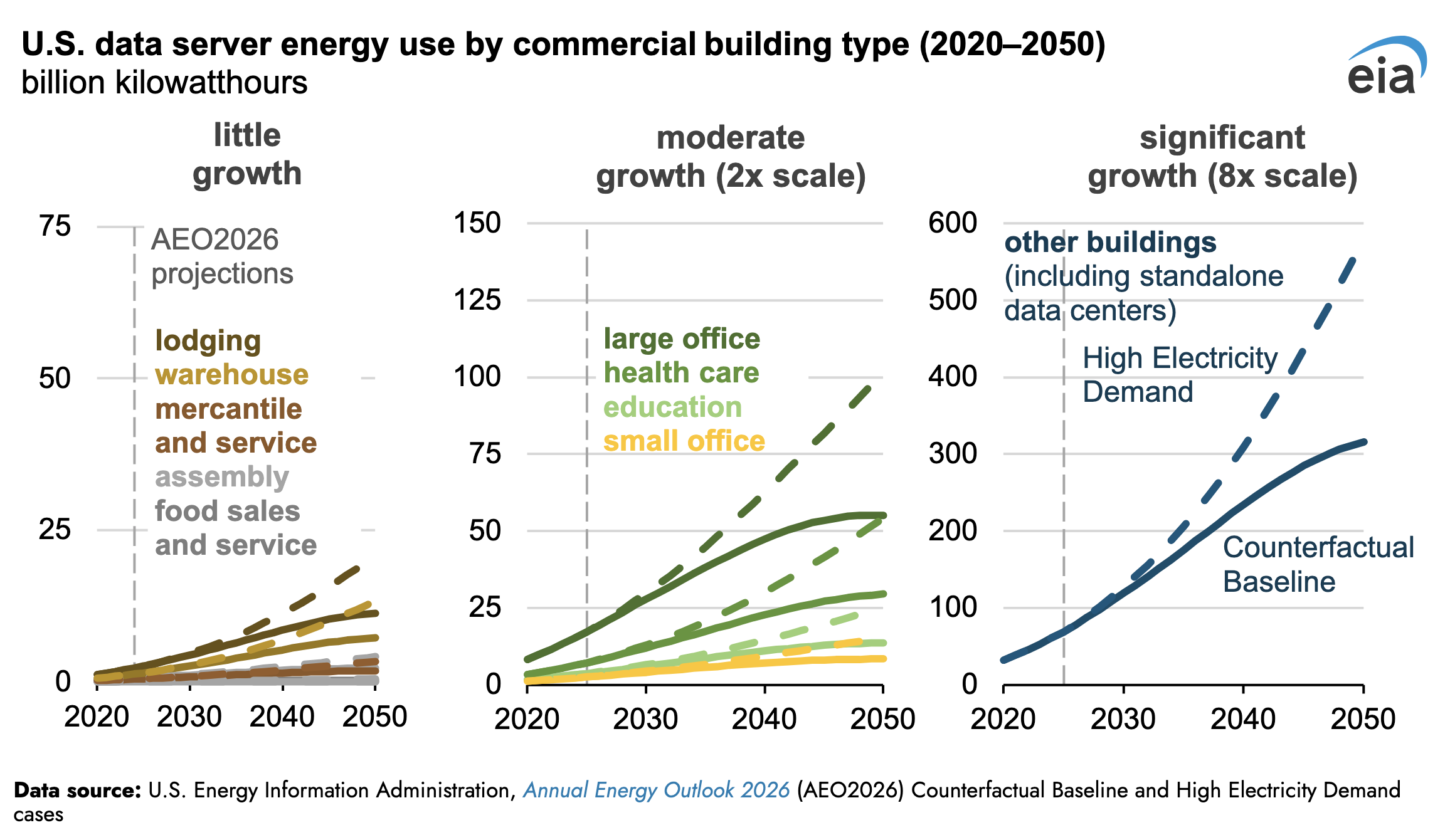
Electricity consumption by data centre servers is projected to rise significantly within the commercial building sector, according to the US Department of Energy’s Annual Energy Outlook 2026 (AEO2026). By 2050, server energy use is expected to reach between 446 billion and 818 billion kilowatt-hours, with standalone data centres accounting for a substantial portion of this demand. This growth means that data centre servers could represent 22% to 33% of the total commercial building electricity consumption by mid-century, up from an estimated 7% in 2025. The report highlights that the increasing energy intensity of commercial buildings is driven largely by data centre operations and their associated cooling requirements. Data centres require significant space cooling to maintain efficient operation of servers and IT equipment, with cooling energy use estimated to be nearly three times more intensive than that of non-data centre spaces. Variations in population trends and climate conditions are expected to influence the demand for cooling energy, with the High Electricity Demand scenario projecting an additional 84 billion kilowatt-hours of cooling consumption by 2050 compared to the baseline. AEO2026 also introduces a refined modelling approach that separates data centre server electricity use from other commercial computing loads, revealing a relatively flat daily demand profile for server power. While the baseline scenario assumes ongoing improvements in server energy efficiency—resulting in a 10% reduction in operational power draw every three years after 2040—overall consumption still rises due to the increasing number of servers. In contrast, the High Electricity Demand case assumes less efficiency improvement and a greater share of AI servers, which are more energy-intensive, contributing to higher electricity consumption. These projections underscore the growing challenge of managing energy demand in commercial buildings as digital infrastructure expands. The findings suggest that efforts to improve server efficiency, alongside innovations in cooling technologies and energy management, will be critical to mitigating the environmental impact of data centre growth. Policymakers and industry stakeholders may need to consider these trends when planning future energy infrastructure and sustainability strategies.