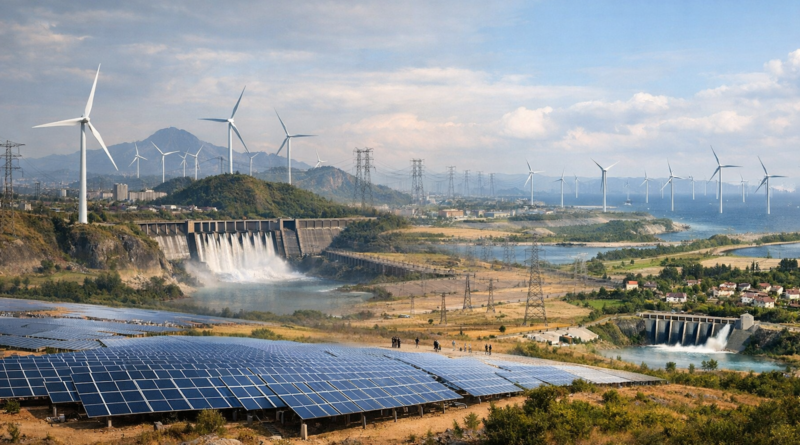
Summary By: eMotoXChina continues to dominate the global clean power landscape, with an installed capacity of wind, water, and solar (WWS) totalling approximately 2,276 GW by the end of 2025. This figure dwarfs other nations, being nearly six times that of the United States and almost nine times India’s total. China’s scale of deployment firmly establishes it as the new epicentre of the global energy transition, overshadowing traditional leaders such as the US and Europe. Its vast buildout includes around 640 GW of wind, 1,200 GW of solar, and 436 GW of hydroelectric power, reflecting a comprehensive and aggressive approach to decarbonising its electricity system.
India’s rapid expansion in renewables is reshaping global rankings and challenging old perceptions of clean energy development. In fiscal year 2026 alone, India added 44.6 GW of solar capacity, pushing its total solar installations to over 150 GW. Combined with its wind and hydro assets, India’s WWS capacity reached nearly 258 GW, placing it among the world’s largest clean electricity systems. This growth is particularly significant given India’s population of 1.46 billion and its relatively smaller economy compared to the US, signalling that large-scale renewable deployment is no longer confined to wealthy nations but is becoming an industrial-scale endeavour in emerging economies.
Europe remains a formidable player in clean energy, with a WWS capacity of around 1,047 GW by 2025, supported by strong policy coordination across multiple countries. The continent’s renewable mix includes 304 GW of wind, nearly 400 GW of solar, and 263 GW of hydro power, illustrating a balanced and mature clean energy infrastructure. Despite this, Europe’s total capacity is less than half of China’s, highlighting the sheer scale of China’s buildout. Nonetheless, Europe’s achievements demonstrate the impact of sustained policy alignment and regional cooperation in accelerating the energy transition.
The United States, despite its vast natural resources, technological expertise, and economic strength, lags significantly behind its global peers in clean power buildout. With about 380 GW of WWS capacity, the US trails Europe by over 600 GW and China by nearly 1,900 GW. This gap is striking given America’s abundant solar and wind resources, large hydro assets, and deep capital markets. The shortfall is attributed primarily to fragmented policy frameworks and challenges in expanding transmission infrastructure, underscoring that the barriers to clean energy deployment are increasingly political and structural rather than technical or financial.
Hydropower remains a crucial and often underappreciated component of the global renewable energy mix, providing essential grid balancing and dispatchable capacity. Countries like Brazil and Canada benefit from large hydro fleets that complement their wind and solar installations, offering a more stable and flexible clean energy system. India’s significant hydro capacity also plays a vital role in its renewable portfolio. This diversity in renewable sources highlights that the energy transition involves more than just solar and wind expansion; it requires integrating various