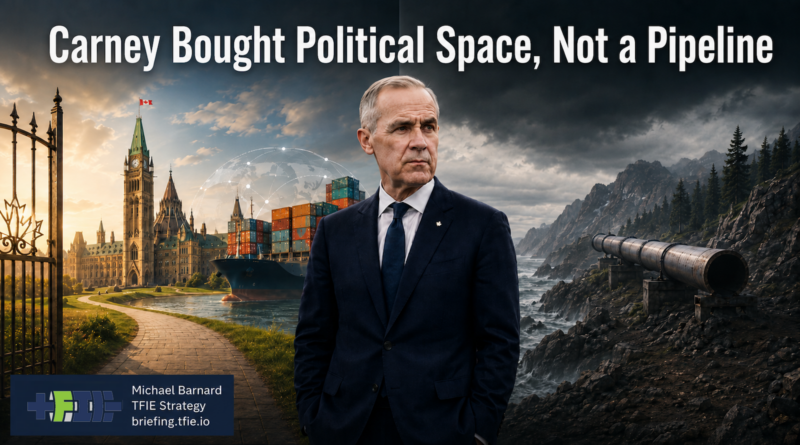
Summary By: eMotoXPrime Minister Mark Carney’s recent agreement on a new Alberta pipeline is primarily a political manoeuvre rather than a concrete infrastructure commitment. The deal serves to signal that Canada remains open for business, offering a potential route for trade diversification away from the United States and countering narratives that Ottawa is hostile to resource development and Alberta’s economic interests. While the announcement provides political capital for Carney and his government, the pipeline itself lacks the essential elements required to transition from concept to reality, such as financing, a committed proponent, a defined route, and necessary regulatory approvals.
The deal outlines a framework for a potential Alberta-to-west-coast pipeline, with construction possibly starting in 2027, contingent on Indigenous consultation and accommodation. However, this remains far from a funded project. Canada has a history of pipeline announcements that fail to materialise due to complex challenges including capital availability, Indigenous consent, provincial and federal alignment, environmental regulations, and market demand. These factors are not mere formalities but fundamental to any infrastructure project’s viability, and none have been resolved in this instance.
Carney’s strategy reflects broader economic and geopolitical concerns. Canada’s heavy reliance on the US market, combined with increasing trade uncertainties, creates a pressing need for alternative export routes. Alberta’s desire for additional bitumen outlets aligns with Ottawa’s aim to demonstrate that major projects can still progress in Canada. The pipeline deal thus serves as a focal point for discussions on trade diversification and energy security, extending beyond oil to include critical minerals, clean energy technologies, and industrial capacity. This broader diplomatic approach positions Canada as a reliable supplier of strategic resources rather than solely an oil exporter.
Despite its political utility, the pipeline project faces significant obstacles. Opposition from British Columbia and Indigenous groups remains strong, with the Union of British Columbia Indian Chiefs explicitly rejecting fast-tracking the pipeline through their territories. Regulatory uncertainty, challenging terrain, escalating costs, and uncertain future oil demand further complicate the project’s prospects. Industry voices, including Cenovus CEO Jon McKenzie, have labelled the pipeline as unfinanceable under current conditions, highlighting the lack of private-sector support and the heavy burden such a project would place on public finances.
Ultimately, the Alberta pipeline deal is less about delivering new infrastructure and more about creating political and diplomatic space for Canada’s economic ambitions. While it may open doors for broader trade and energy discussions, the absence of a funded project and the myriad unresolved challenges suggest the pipeline itself is unlikely to be built. The agreement exemplifies the complex interplay between political strategy and infrastructure development in Canada’s resource sector, underscoring the difficulties of advancing major energy projects in today’s economic and regulatory environment.