Article By:
CleanTechnica
2026-04-07 16:23:12
Battery Energy Storage Key To India Emissions Reduction Goal
Summary By: eMotoX
India has set ambitious new targets to reduce the carbon intensity of its GDP by 47 percent from 2005 levels by 2035, alongside a commitment to source 60 percent of its electricity capacity from non-fossil fuels by the same year. The country aims to reach net-zero emissions by 2070, signalling a significant shift in its energy policy. Achieving these goals will require substantial investment and innovation, particularly in scaling up renewable energy sources and integrating battery energy storage systems (BESS) to provide reliable, round-the-clock power.
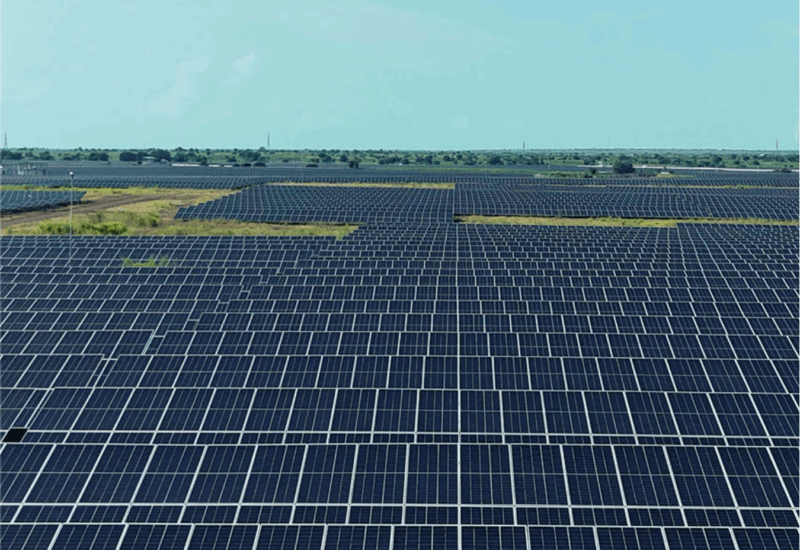
Recent analysis by Ember highlights the critical role of solar power combined with battery storage in meeting India’s electricity demand. Solar energy already accounted for nearly 10 percent of the country’s electricity generation in 2025, with installed capacity surging from under 5 GW in 2015 to 143 GW in 2026. Ember’s report suggests that with the rapidly falling costs of battery storage, India could supply up to 90 percent of its electricity needs through solar and storage at competitive prices, fundamentally transforming the energy landscape and positioning India as a global solar superpower.
Financial and structural challenges remain pivotal to India’s renewable ambitions. According to the Institute for Energy Economics and Financial Analysis (IEEFA), the success of India’s plan to reach 500 GW of renewable capacity by 2030 depends not only on technology and policy but also on the structure of debt finance. The divergence in credit markets is already evident, with renewable energy projects attracting stronger margins and international financing, while thermal power assets face increasing capital market exclusion. This financial shift underscores the growing economic viability and investor confidence in clean energy.
The rapid evolution of battery storage technology is exemplified by developments in other parts of the world, such as California, where batteries now provide a significant portion of evening electricity demand. This transition from solar’s daytime dominance to reliable night-time supply through storage demonstrates the feasibility of integrating intermittent renewables at scale. International examples from the UAE and Chile, which are investing heavily in large-scale battery projects to ensure continuous solar power availability, further illustrate the global momentum behind battery storage as a key enabler of the clean energy transition.
India’s ambitious emissions reduction goals hinge on the successful deployment of solar power paired with advanced battery storage solutions. While the country faces financial and infrastructural hurdles, the declining costs and improving economics of battery systems offer a promising pathway to a more sustainable and resilient electricity grid. As global experience shows, the rapid scaling of these technologies could enable India to meet its climate targets while reducing dependence on imported fossil fuels and enhancing energy security.