Summary By: eMotoXAutonomous logistics is rapidly advancing and scaling in China, with electrified and driverless freight vehicles becoming increasingly common in urban and long-haul applications. At Auto Beijing, several companies showcased their latest models of autonomous delivery vehicles, often referred to as “Robovans,” designed to replace traditional vans for local cargo transport. These vehicles, equipped with Level 4 (L4) autonomous capabilities, are gaining traction across multiple cities, signalling a swift commercialisation of driverless logistics technology in the country.
Key players such as MINIEYE and QCRAFT are pioneering mapless autonomous systems that reduce reliance on high-definition maps, enabling more flexible operation in diverse and unpredictable environments. MINIEYE’s Bamboo Robovan T5 Pro, described as the industry’s first true mapless L4 logistics vehicle, is already active in 18 cities with an updated version set for imminent delivery. Similarly, QCRAFT, founded by former Waymo engineers, leverages a closed data loop to accelerate research and development, with its autonomous logistics robot handling the last few metres of delivery, complementing its L4 Robovan for last-mile transport.
The rapid pace of innovation in China is bolstered by a robust ecosystem of suppliers and technology partners, allowing companies to move from concept to market-ready products at an unprecedented speed. This “China Speed” contrasts with slower development cycles elsewhere and highlights the benefits of a collaborative innovation environment. Autonomous delivery vehicles with payloads around 1,000 kg and ranges near 200 km are being offered at competitive prices, with the elimination of driver costs promising swift returns on investment despite slightly higher upfront costs compared to conventional electric vans.
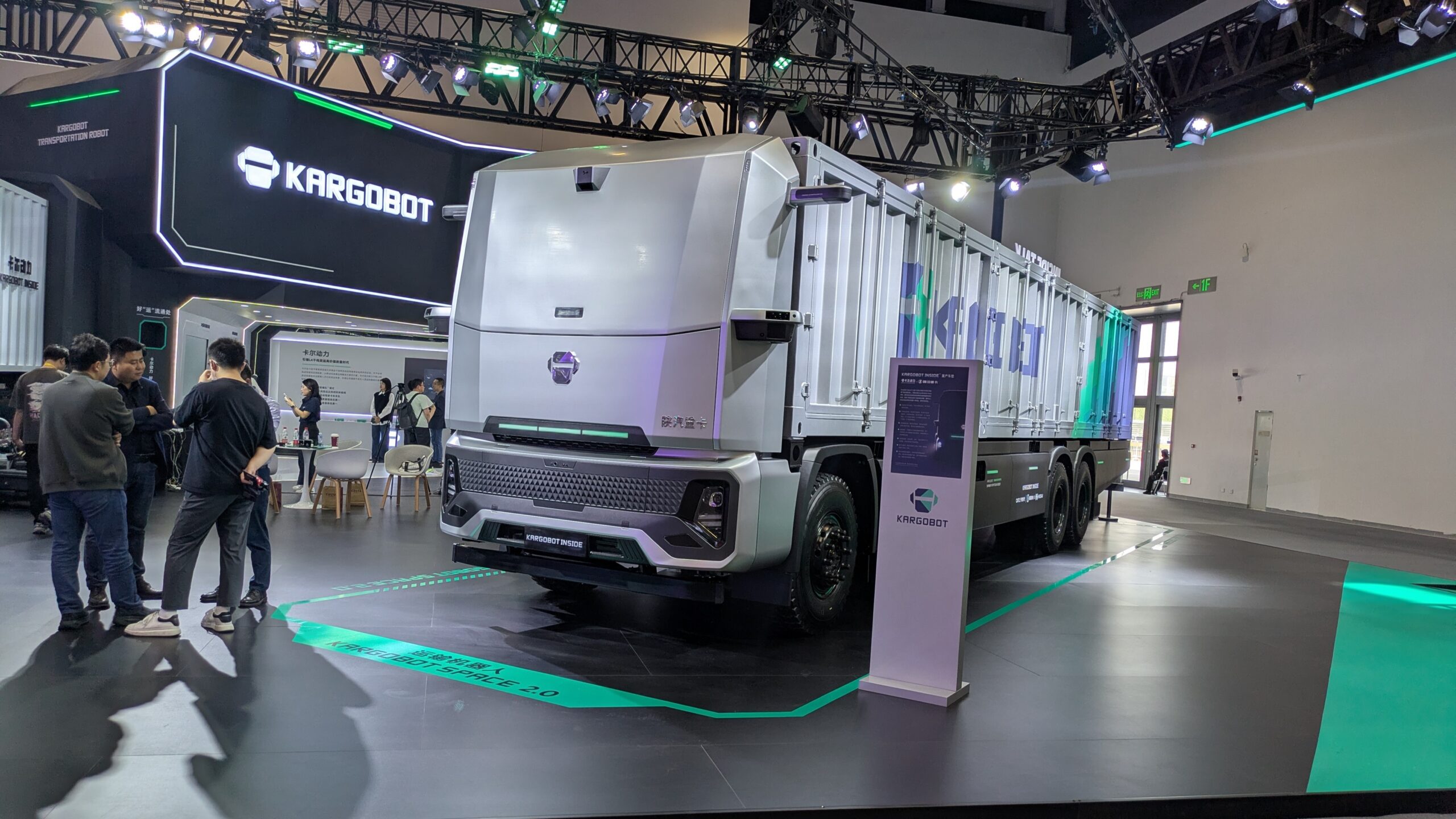
On the larger end of the spectrum, Carl Dynamics presented the KargoBot Space, a fully driverless, four-axle autonomous freight vehicle designed for bulk commodity transport. This model, developed in partnership with battery manufacturer CATL, features battery swap technology enabling up to 2,000 km of daily autonomous operation. By removing the driver’s cab, the KargoBot Space increases cargo capacity by 25% and reduces logistics costs by an estimated 35%, while its ability to drive in platoons further enhances efficiency through reduced aerodynamic drag.
China’s focus on autonomous cargo vehicles offers a distinct pathway to autonomy, with fewer regulatory hurdles and faster development cycles compared to passenger vehicles. The relative simplicity of logistics applications allows manufacturers to prioritise autonomous driving capabilities without the complexities of crash testing or passenger comfort standards. Insights gained from these cargo models are expected to inform future autonomous passenger transport solutions, potentially accelerating the broader adoption of self-driving technology worldwide.