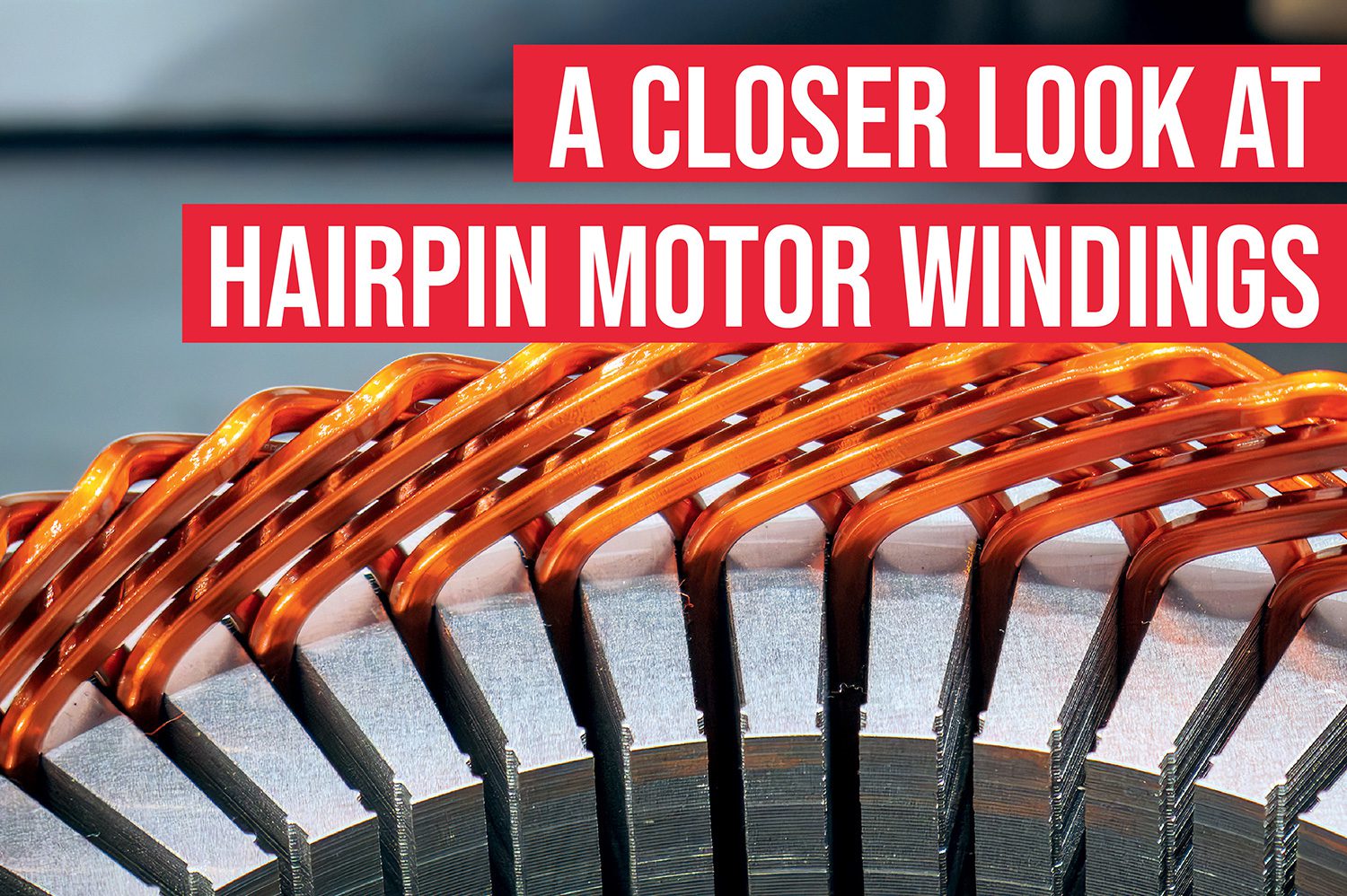
Summary By: eMotoXHairpin motor windings, a technology long promoted as a potential advancement in electric vehicle (EV) traction motors, offer a method of increasing the copper fill within a motor’s stator. Unlike traditional windings made from multiple strands of magnet wire, hairpin windings use short, thick copper segments bent into a distinctive shape that allows for a higher packing density inside the stator slots. While this design can improve the slot fill factor from around 55% with conventional wire windings to approximately 70%, the overall benefits depend heavily on factors such as operating frequency, current density, insulation requirements, and manufacturing costs.
Traditional magnet wire windings remain prevalent due to their flexibility and extensive manufacturing heritage, which spans over a century. These windings allow for a wide range of wire gauges, numbers of turns, and configurations—whether concentrated or distributed—making them adaptable to various motor designs. However, their main limitation lies in the relatively low fill factor caused by the insulation coating on each wire strand, which reduces the effective copper area within the stator slots. Attempts to use larger, single conductors to improve fill often run into practical challenges, such as difficulty in winding and risks of insulation damage.
Hairpin windings address some of these issues by using larger, preformed copper segments that fit precisely into stator slots and are welded together to form complete coils. This design reduces the risk of insulation damage during assembly and allows for a higher copper fill, potentially increasing motor efficiency and power density. Nonetheless, hairpin conductors face their own constraints, particularly from the skin effect, where alternating current tends to flow near the surface of thick conductors at higher frequencies, increasing resistance. Engineers can partly mitigate this by using rectangular cross-sections for hairpins, which maximise copper area while limiting losses.
The choice between concentrated and distributed winding configurations also plays a role in motor performance, especially concerning torque ripple and vibration. Concentrated windings have one coil per pole per phase and tend to produce more torque ripple, whereas distributed windings spread coils across multiple stator slots, smoothing out the torque output. Hairpin windings are often associated with concentrated designs due to their manufacturing process, which may influence the motor’s acoustic and mechanical characteristics.
Ultimately, hairpin windings represent a complementary technology rather than a wholesale replacement for traditional wire windings. Their advantages are context-dependent, offering clear benefits in certain applications but not universally outperforming conventional methods. As electric motor design continues to evolve, manufacturers will likely integrate both winding types where appropriate, balancing performance gains against cost and reliability considerations.