electric vehicle news article header featuring EV news, electric car updates, charging technology and industry insights

News Menu

bicycle news feed and industry updates for eBike and cycling news
Click for Bicycle News
latest eBike news aggregator covering electric bike updates, reviews and industry trends
Click for eBike News
electric motocross news feed with latest dirt bike updates, reviews and industry insights
Click for eMotocross News
electric vehicle news aggregator featuring latest EV updates, charging and technology news
Click for EV news
Article By:
Rider Guide
2026-06-11 05:31:17

Electric Scooter Range: Claimed vs. Tested (We Measured 12 Scooters)

Summary By: eMotoX
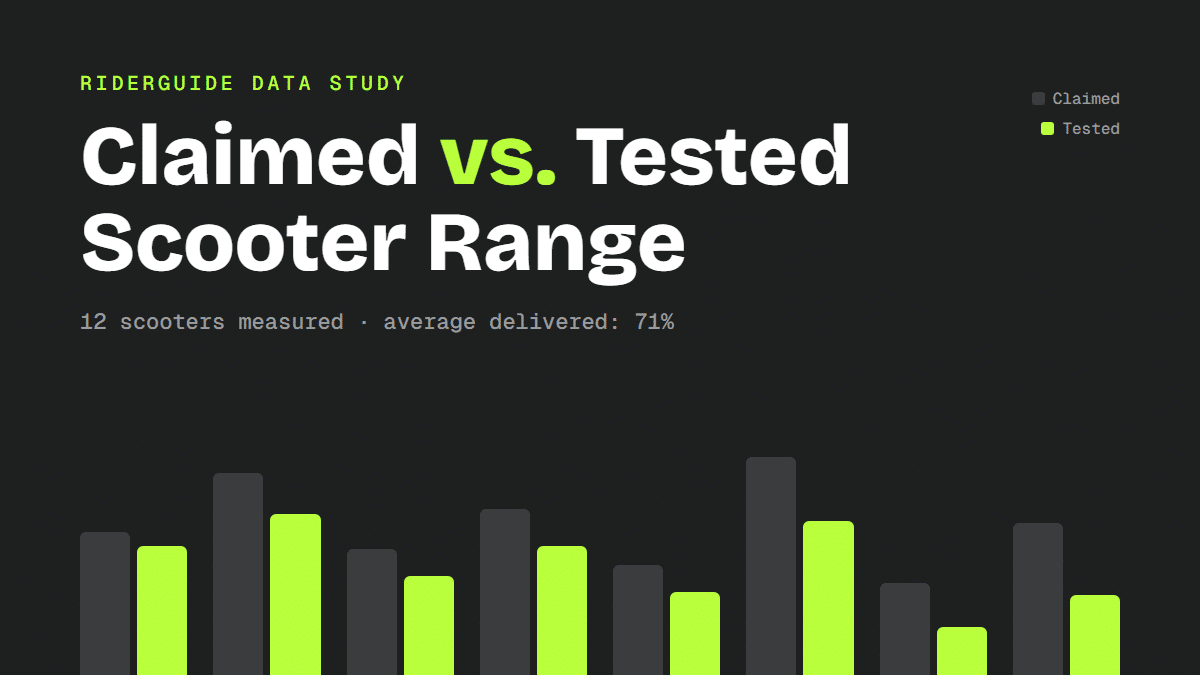
A recent comparative test of 12 popular electric scooters reveals that, on average, these vehicles deliver just 71 percent of their manufacturer-claimed range under real-world conditions. The evaluation, conducted using a standardised urban riding loop that includes stops, hills, and typical commuting speeds, found a wide disparity between claimed and actual distances. The VMAX VX5 Pro GT emerged as the most accurate model, achieving 90 percent of its advertised range, while the Segway Ninebot Max G30P fell short, delivering only 53 percent of its claim. The study highlights that scooters with more modest range claims tend to be more reliable, with the four most honest models all advertising ranges under 27 miles. In contrast, scooters boasting the highest claims—such as the EMOVE Cruiser S62 and Segway Ninebot Max—consistently underperformed, reaching 70 percent or less of their stated distances. This discrepancy is largely attributed to the idealised conditions manufacturers use for their tests, which typically involve a lightweight rider on flat terrain, maintaining a steady, slow speed without stops. Real-world factors such as rider weight, terrain, weather conditions, and stop-and-go traffic significantly reduce battery performance. The report advises prospective buyers to multiply manufacturer range claims by 0.7 to estimate realistic distances, or alternatively, to divide the scooter’s battery capacity in watt-hours by 30 to gauge expected mileage. Heavier riders and those frequently tackling hills or riding in cold weather should anticipate even lower ranges, sometimes as low as half the claimed figure. Matt Kaye, who has tested over 200 electric rides since 2018, emphasises the importance of realistic expectations when shopping for scooters. He notes that no manufacturer deliberately exaggerates range claims; rather, these figures represent best-case scenarios that rarely reflect everyday use. The findings serve as a practical guide for consumers, encouraging them to prioritise tested range data over marketing claims to ensure their chosen scooter meets commuting needs reliably.