Article By:
CyclingNews
2026-04-09 11:00:00
Paris-Roubaix tech predictions 2026: What we expect to see in the pits at the Queen of the Classics
Summary By: eMotoX
The Paris-Roubaix race, often dubbed the "Hell of the North," continues to be a hotbed for cycling technology innovation, frequently outpacing even the Tour de France in terms of equipment advancements. Recent years have seen a shift away from specialised Roubaix bikes towards more versatile aero or endurance models, largely enabled by the widespread adoption of disc brakes that allow for wider tyre clearances. This evolution has led teams to experiment with gravel-style bikes and prioritise rolling resistance, reflecting a broader trend in race strategy and bike design.
One of the clearest developments heading into the 2026 edition is the increasing use of wider tyres. Riders have progressively moved from 30mm to 32mm tyres on the cobbles, with some experimenting with 35mm variants. Continental’s recent launch of a 35mm GP5000 S TR tyre, which performed exceptionally well in lab tests, is expected to become popular among teams able to fit them. Although Vittoria offers even wider tyres up to 42mm, it is unlikely that top teams will adopt these due to UCI regulations and performance trade-offs.
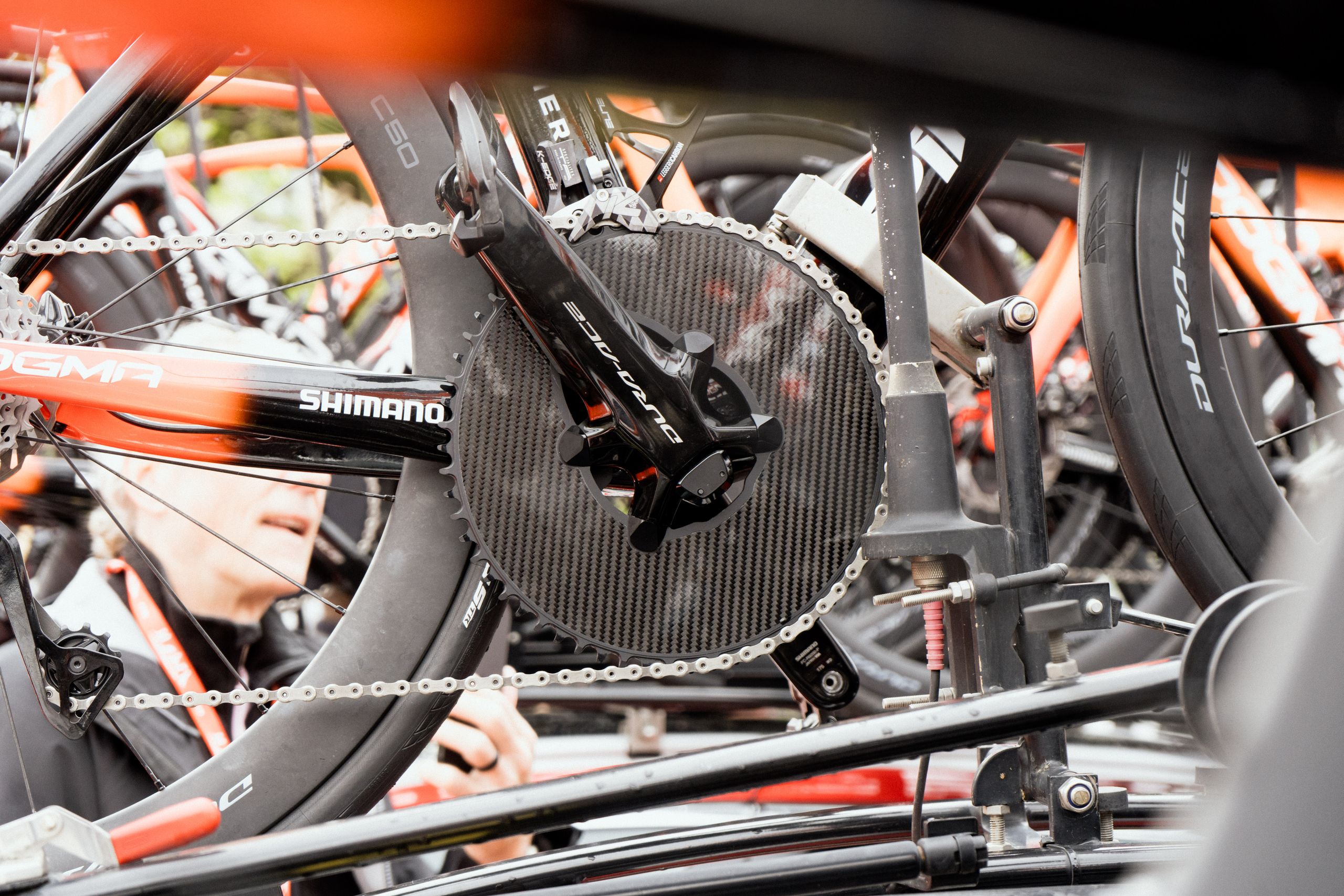
Another significant trend is the near-universal adoption of 1x drivetrains among most teams, particularly those sponsored by Shimano and SRAM. The single front chainring setup offers aerodynamic benefits, weight savings, and crucially, allows for larger tyre clearances by removing the front derailleur, which often restricts frame design. Notably, Tadej Pogačar’s recent victory at Milan-San Remo on a 1x setup signals a potential shift for Roubaix contenders. However, Alpecin-Premier Tech and Mathieu van der Poel are expected to buck this trend, sticking with their traditional 2x systems and more conservative equipment choices, reflecting their success and preference for proven setups.
Mathieu van der Poel’s equipment choices exemplify a reluctance to embrace newer tech despite the availability of purpose-built Roubaix bikes like the Canyon Endurace. Instead, he is likely to race on his familiar Canyon Aeroad, which he has used to win multiple editions. This decision underscores the balance riders strike between innovation and reliability, especially in a race as unpredictable and grueling as Paris-Roubaix.
Finally, safety measures around tyre security are evolving, with teams like Visma resorting to gluing tubeless tyres to rims to prevent blowouts and wheel failures, which have historically plagued the race. Despite tyre inserts and robust wheel designs, catastrophic tyre separation remains a risk on the cobbles, prompting teams to adopt extra precautions. This cautious approach highlights the ongoing challenges of balancing performance and durability in one of cycling’s toughest events.