bicycle news article header featuring cycling news, bike updates, reviews and industry insights

News Menu

latest eBike news aggregator covering electric bike updates, reviews and industry trends
Click for eBike News
electric motocross news feed with latest dirt bike updates, reviews and industry insights
Click for eMotocross News
latest eScooter news aggregator featuring electric scooter news feed, updates, reviews and industry trends
Click for eScooter News
electric vehicle news aggregator featuring latest EV updates, charging and technology news
Click for EV news
Article By:
Cycling Weekly
2026-04-13 06:00:00

Huge tyres, off-road rear mechs, and single chainrings galore: All the tech we spotted at Paris-Roubaix

Summary By: eMotoX
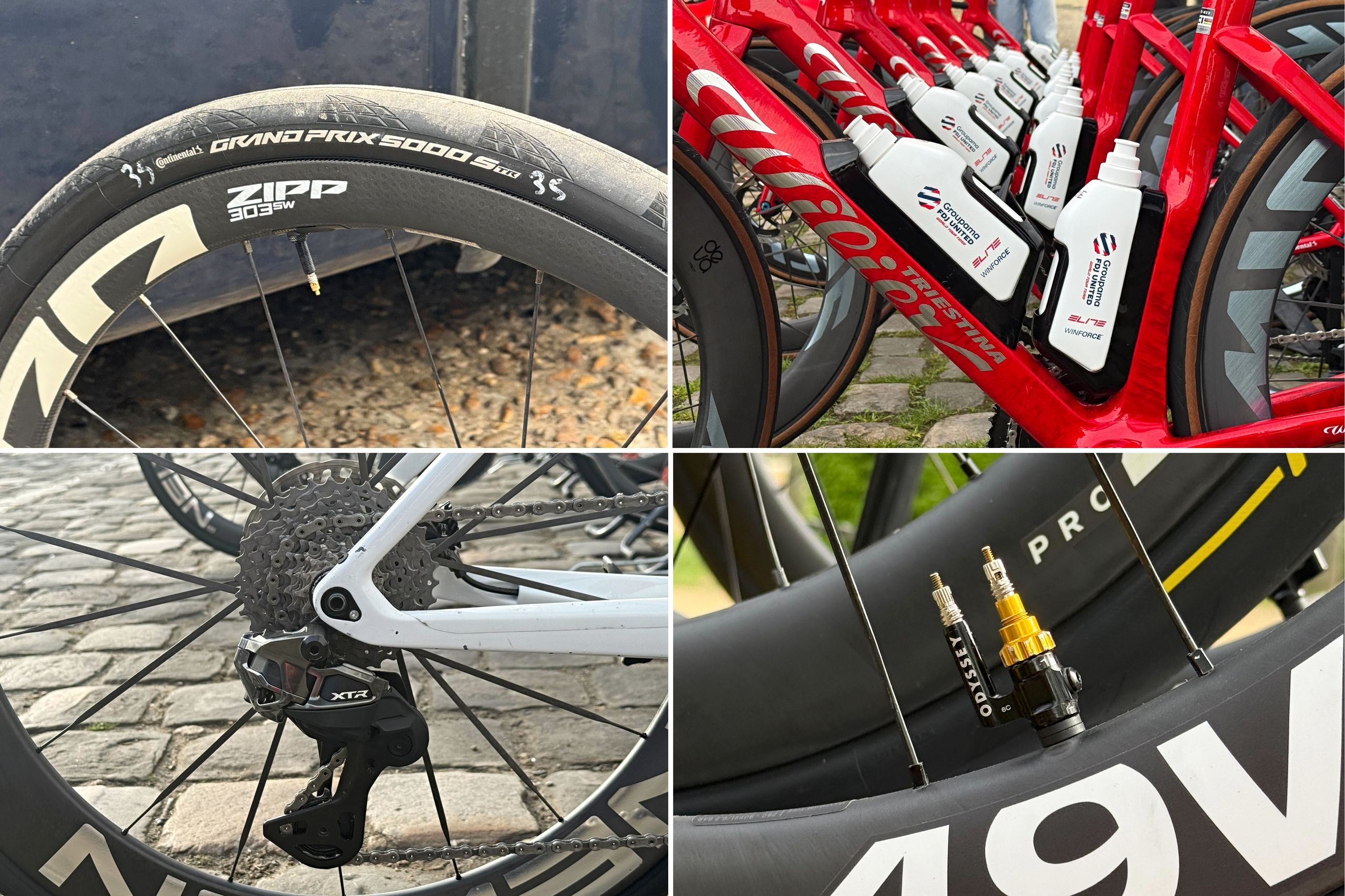
Paris-Roubaix continues to challenge conventional road bike design, with teams pushing the boundaries of equipment to endure the punishing cobbled sectors. This year’s race saw a notable trend towards wider tyres, with many riders opting for sizes up to 35mm, a significant increase from the previously radical 30mm. Teams such as UAE Team Emirates, Movistar, and Decathlon CMA CGM embraced these larger tyres where frame clearance allowed, often pairing a 35mm tyre at the front with a slightly narrower 32mm at the rear. This approach appears to balance the benefits of increased volume and comfort with considerations of acceleration and rotational mass. Beyond tyre width, tubeless setups remain a source of concern among riders, prompting some teams to experiment with innovative solutions to reduce puncture risk. Lidl-Trek, for example, employed a dual-valve system from BMX brand Odyssey, which incorporates a tyre insert designed to prevent burping and protect the rim from impacts. This system also offers a temporary run-flat capability, a valuable fail-safe on the unforgiving cobbles. Such developments highlight the ongoing tension between reliability and performance in the harsh conditions of Paris-Roubaix. Drivetrain configurations have also evolved, with single chainring (1x) setups becoming the norm, though teams are adopting increasingly unconventional methods to achieve them. SRAM’s XPLR gravel groupsets remain popular, offering wide-range cassettes suited to the varied terrain. However, some Shimano-supported teams have taken a more eclectic approach, mixing mountain bike and gravel components to enhance chain retention and durability. TotalEnergies and Ineos Grenadiers notably trialled mountain bike XTR rear derailleurs alongside gravel and road groupsets, signalling a willingness to prioritise practical chain security over traditional equipment uniformity. These technical adaptations underscore the unique demands of Paris-Roubaix, where survival often trumps outright optimisation. The race continues to serve as a testing ground for innovations that blur the lines between road, gravel, and mountain bike technology. As teams refine their setups in response to the evolving challenges of the course, future editions may see even more radical departures from conventional road racing norms, reflecting the relentless quest to combine speed, resilience, and rider comfort on the cobbles.