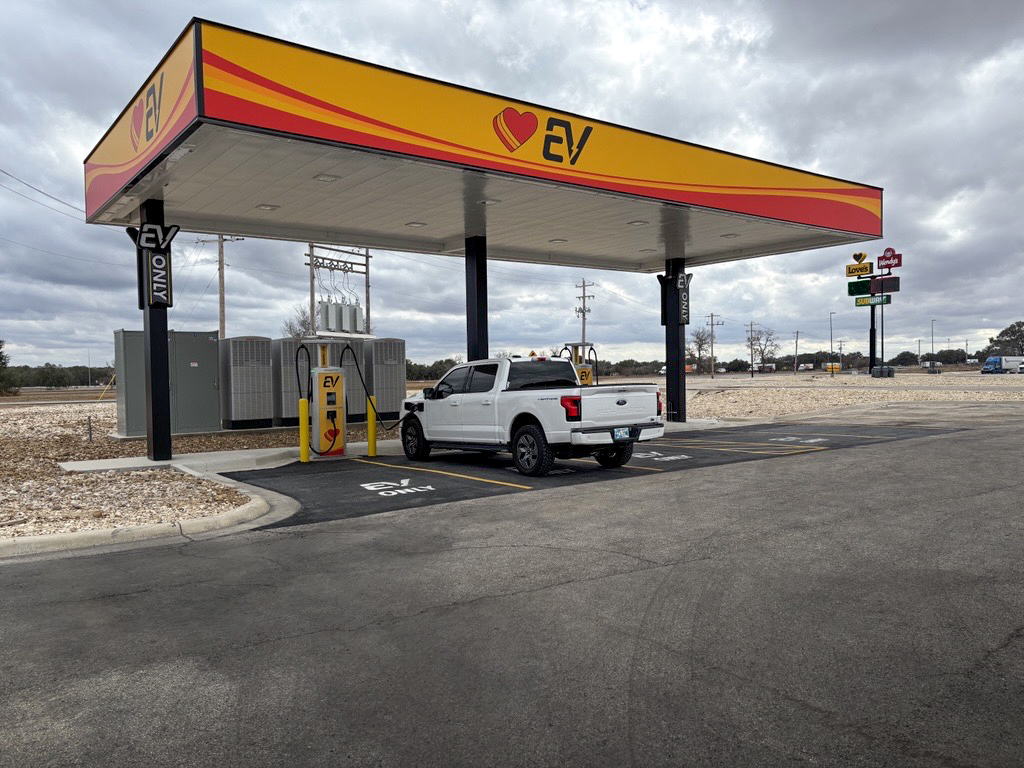
Summary By: eMotoXLove’s Travel Stops has inaugurated its first three electric vehicle (EV) charging stations in Texas, located in Natalia, Encinal, and Three Rivers, each equipped with four chargers supporting both NACS and CCS ports. Notably, the Three Rivers site also features eight Tesla Superchargers. Positioned south of San Antonio along major highways, these stations offer convenient amenities such as restrooms, food and beverages, wi-fi, and covered canopies, aiming to enhance the overall charging experience for drivers.
The strategic placement of these chargers, with distances of roughly 76 to 90 miles between locations, facilitates long-distance travel for EV owners by reducing range anxiety. Commenters on LinkedIn praised the thoughtful design, highlighting the dedicated EV islands with canopies that help maintain smooth traffic flow and improve customer comfort during charging stops. Love’s has announced plans to expand its EV charging network further across Texas within the year, signalling a growing commitment to supporting electric mobility.
In addition to the Texas rollout, four new fast chargers have been installed near Bangor, Maine, at the Alltown Convenience Market in Orono. These stations offer two NACS and two CCS ports, further bolstering regional EV infrastructure. James Cater, Senior Director of Sustainability Strategy and Innovation at Global Partners, emphasised that the Maine installation marks a significant step towards providing comprehensive fueling options and advancing clean energy goals in the state.
This expansion of EV charging infrastructure by mainstream retailers like Love’s Travel Stops reflects a broader trend in the United States, where companies such as Walmart, Kroger, Sheetz, Wawa, and Shoprite are also investing in EV chargers at their locations. The increasing availability of public chargers in both urban and intercity areas is crucial for supporting the growing number of EV drivers and encouraging wider adoption by alleviating concerns over vehicle range and charging accessibility.