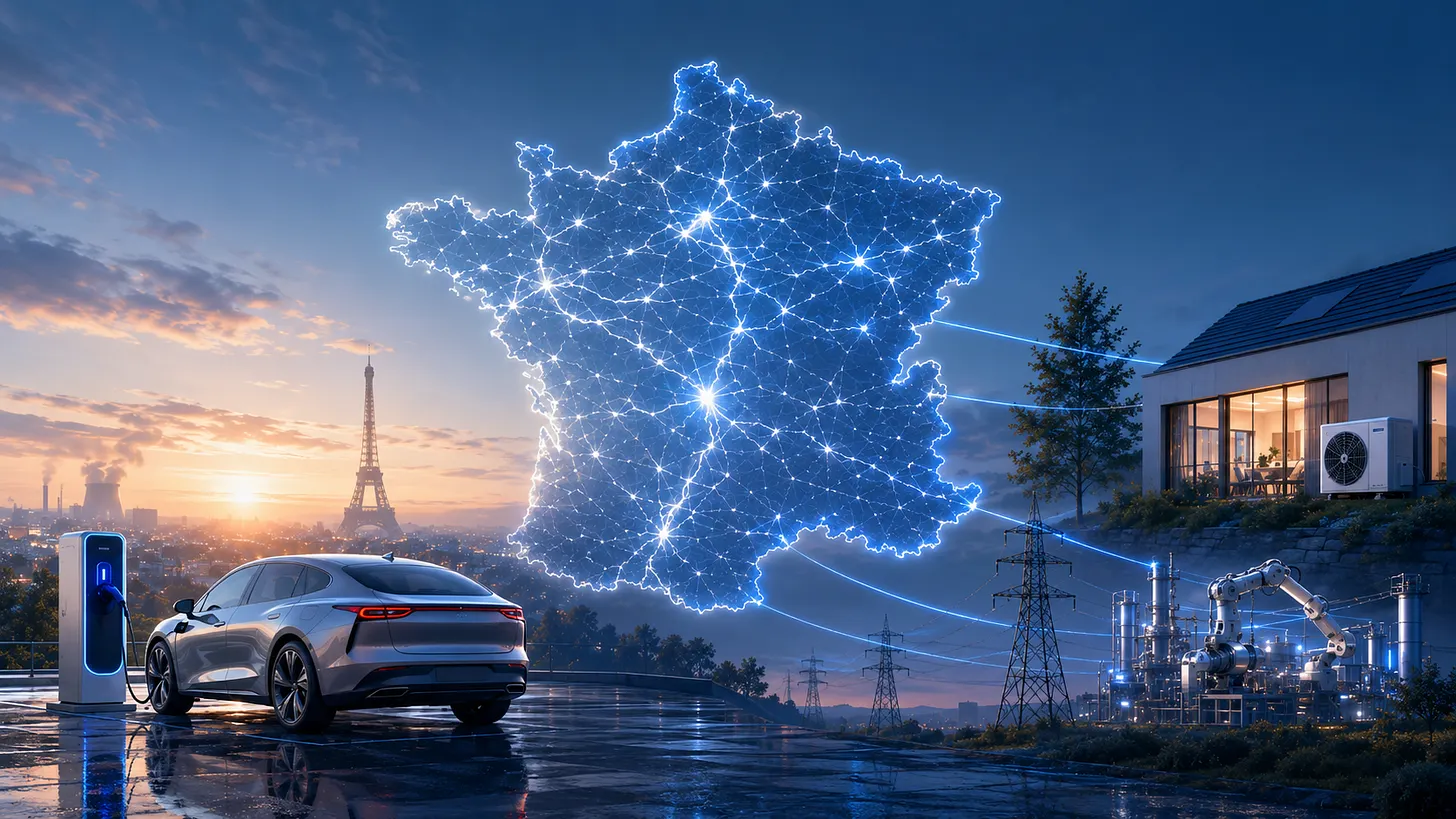
Summary By: eMotoXFrance has unveiled an ambitious national electrification strategy that frames clean electricity as a cornerstone of energy security, industrial policy, and consumer protection. Rather than treating electrification as a peripheral climate measure or a series of isolated incentives, the plan integrates it as a fundamental shift away from fossil fuel dependence towards domestically produced low-carbon power. This approach aims to reduce emissions, shield the economy from fossil fuel price volatility, and enhance national control over energy resources, leveraging France’s already low-carbon electricity system dominated by nuclear power.
The government’s target is to increase the share of domestically generated electricity to 60% of the country’s energy mix by 2030, backed by a doubling of public support to €10 billion annually. The initiative spans multiple sectors, including power generation, heating, transport, and industry, with a strong emphasis on scaling up heat pumps, phasing out gas heating in new buildings, expanding electric vehicle access for lower-income drivers, and boosting domestic EV production and charging infrastructure. The plan is also positioned as an industrial strategy, with projections of safeguarding or creating over 600,000 jobs, reflecting a comprehensive effort to align energy transition with economic growth.
A key strength of France’s approach lies in its focus on direct electrification, which is more efficient and practical than relying heavily on alternative fuels like hydrogen or synthetic molecules. By prioritising electric heat pumps, battery-electric vehicles, and electrified industrial processes, the strategy addresses a broad range of sectors where electricity can replace fossil fuels effectively. This contrasts with ongoing debates that often get bogged down in discussions about importing or producing new fuels, highlighting France’s unique position due to its existing low-carbon electricity infrastructure.
Despite the plan’s clear strategic vision, significant challenges remain. The 2030 timeline is tight, requiring rapid scaling of supply chains, workforce training, infrastructure upgrades, and streamlined permitting processes. The reliability of France’s nuclear fleet, the pace of renewable deployment, and the readiness of grids and buildings will all be tested. Moreover, while the funding increase is politically significant, much of it involves reallocating existing resources rather than new investment, making the details of implementation critical to success.
Ultimately, France’s electrification pact stands out for its integrated approach, linking demand-side measures with supply-side capacity in a coherent energy transition framework. While the goals are ambitious, the plan’s success will depend on overcoming practical hurdles and ensuring that policy, finance, industry, and infrastructure development proceed in concert. If delivered effectively, it could serve as a model for other nations seeking to move beyond fossil fuels through direct electrification.