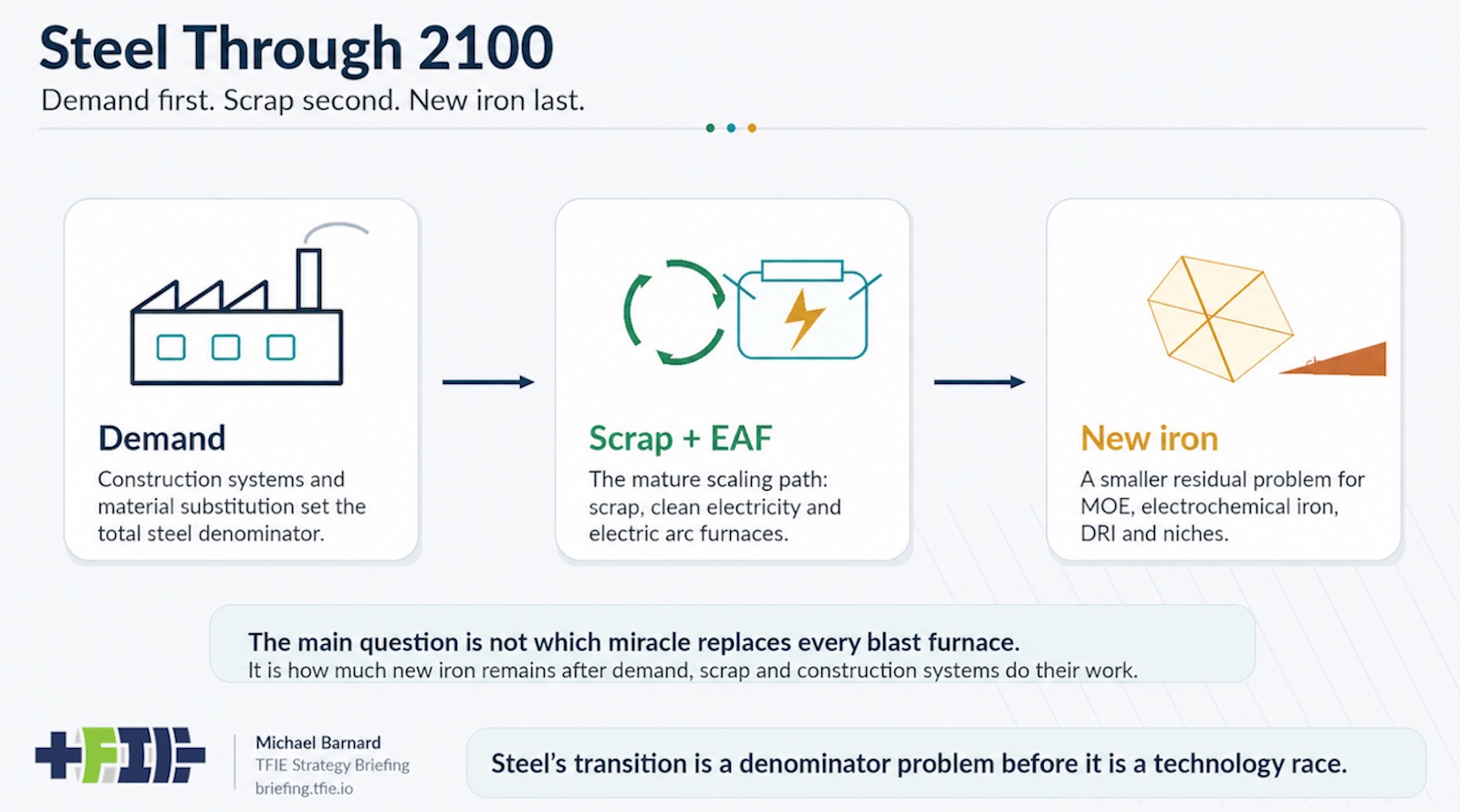
Summary By: eMotoXThe decarbonisation of steel production hinges primarily on managing demand, maximising scrap recycling, and expanding the use of electric arc furnaces (EAFs), rather than relying heavily on hydrogen technologies. While hydrogen has been widely touted as a promising solution to replace coal in blast furnaces, this perspective oversimplifies the transition by focusing on a single technological fix. Instead, the critical factors include how much steel is actually needed globally, the rate at which steel scrap is recovered and reused, and the pace at which EAF capacity grows. Hydrogen may play a role in addressing the residual demand for new iron, but it is not the starting point of the steel sector’s decarbonisation pathway.
Global steel production currently stands at around 1.9 billion tonnes annually, much of it still produced using traditional blast furnace methods reliant on coal and iron ore. Steel’s widespread use across infrastructure, transport, and industrial equipment makes it a significant contributor to carbon emissions. However, the challenge is not mysterious; it is fundamentally about material flows and demand patterns. Recent analyses have highlighted that the unprecedented construction boom in China from 2000 to 2020, a major driver of steel demand, is unlikely to be replicated elsewhere at the same scale or intensity. This insight shifts the outlook on future steel demand and, by extension, the scale of the decarbonisation challenge.
Scrap steel recovery emerges as a pivotal element in reducing emissions, given steel’s long lifespan and recyclability. Much of future steel demand can be met with recycled steel, making electric arc furnaces—which use electricity to melt scrap and other metallic inputs—a mature and scalable technology. Unlike emerging hydrogen-based processes, EAFs are already commercially viable and dominant in certain markets, with emissions linked directly to the cleanliness of the electricity used. Nevertheless, challenges such as scrap quality, regional availability, and electricity costs remain, but these are manageable within existing industrial frameworks.
Hydrogen direct reduced iron (DRI) technology, while technically feasible and capable of producing low-emission steel when paired with clean electricity, faces a more complex competitive landscape. It must compete not only with traditional blast furnaces but also with strategies that reduce steel demand, improve scrap utilisation, and leverage cleaner electricity in EAFs. Moreover, hydrogen-based methods require the development of an entire fuel supply chain, adding layers of complexity and cost. Consequently, hydrogen should be viewed as part of a broader portfolio of solutions rather than a silver bullet.
The steel sector’s transition will depend heavily on real-world progress, including the retirement of blast furnaces, increased EAF utilisation, improved scrap collection, and procurement policies favouring low-carbon steel. Pilot projects and announcements around hydrogen and carbon capture are insufficient on their own to drive systemic change. Instead, a comprehensive approach that prioritises demand management, recycling, and electrification offers a clearer and more immediate pathway to decarbonisation, with hydrogen playing a supporting role in addressing the remaining new iron production needs.