Summary By: eMotoXKen Evans’ 1971 Carlton time trial bike stands as a remarkable example of 1970s specialist TT design, prioritising stiffness and power transfer over mere lightness. Evans, a passionate short-distance time triallist and editor of Cycling Weekly during that era, commissioned the bike to maximise straight-line speed, reflecting the period’s focus on aerodynamic efficiency and raw performance. The bike’s construction and components offer a fascinating insight into the engineering approaches of the time, blending innovation with traditional craftsmanship.
The frame itself is particularly unusual, featuring uniform 1 1/8-inch Reynolds 531 double-butted tubing across the top, down, and seat tubes, rather than the more common variation in tube diameters. This design choice, combined with lugless fillet brazing, enhanced the frame’s stiffness significantly, enabling better power transfer. Carlton also incorporated a continuous seat tube, a rare feature that may have introduced some compliance, foreshadowing design elements only popularised decades later by modern brands such as Open.
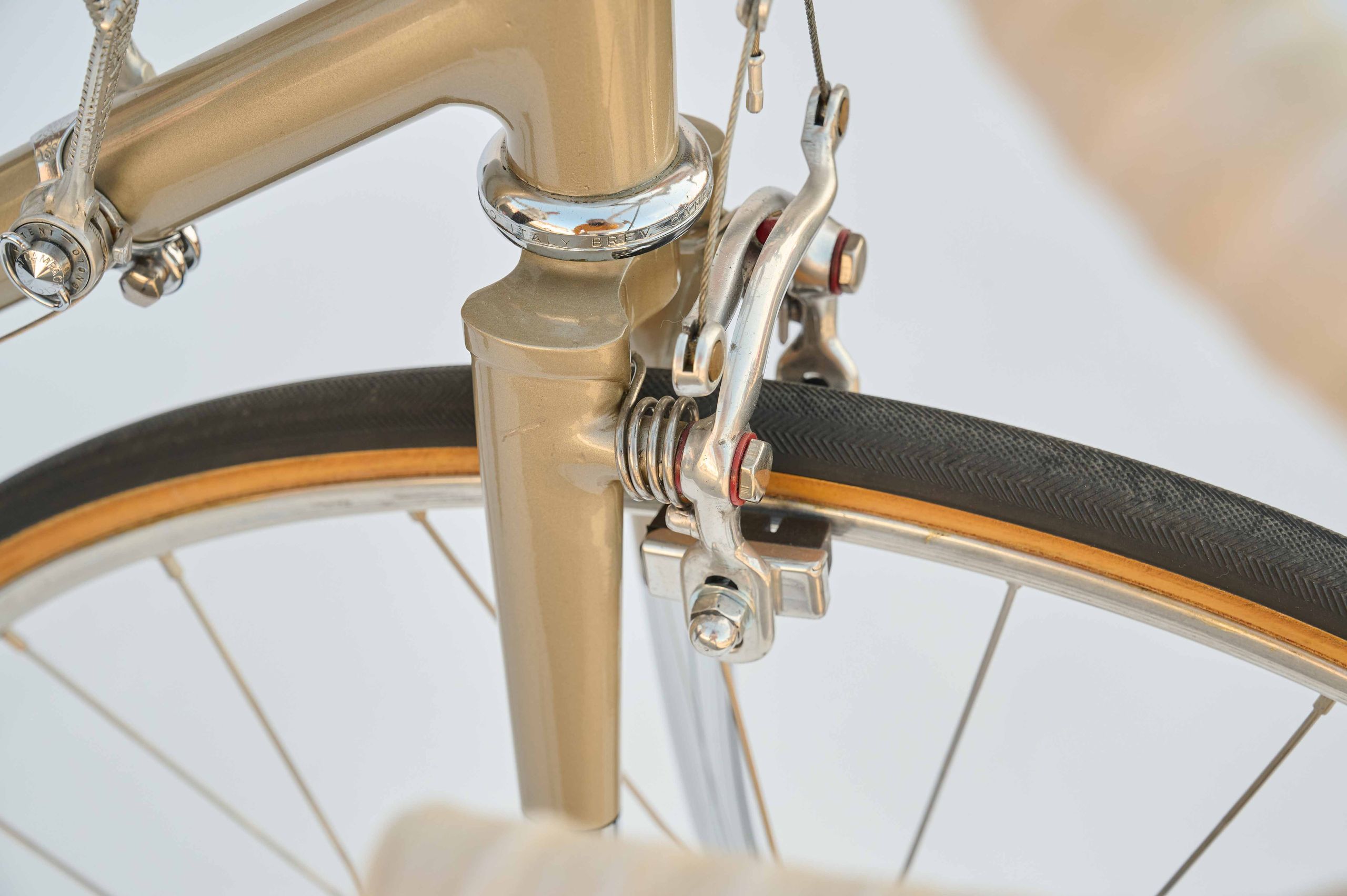
Innovative touches extend to the bike’s cable routing and braking system, both the work of Carlton manager and designer Gerald O’Donovan. The rear brake cable takes an unconventional path, passing through eyelets on the top tube before running inside a small pipe brazed through the seat tube, a striking and possibly aerodynamic solution. More notably, the direct-mount brakes were decades ahead of their time, with modified Universal callipers mounted on prongs brazed to the forks and stays, enhancing stiffness and braking performance.
Despite these avant-garde features, the rest of the build is relatively conventional by comparison, featuring Campagnolo components throughout, including a mix of Nuovo and Super Record groupsets. The bike is finished with 3ttt aluminium bars and stem, factory-drilled Mafac levers, and Campagnolo large flange hubs laced to lightweight Super Champion rims, shod with Vittoria tubular tyres. This combination balanced innovation with proven reliability, making the bike a unique yet practical machine for its era.
The Carlton TT bike not only highlights the ingenuity of 1970s frame builders but also serves as a historical benchmark for the evolution of time trial technology. Its blend of stiffness-focused engineering, creative cable routing, and pioneering brake mounts offers valuable lessons for modern designers and enthusiasts alike. As the current custodian Dave Marsh notes, the bike remains a testament to the creative spirit and technical experimentation that defined cycling’s golden age.