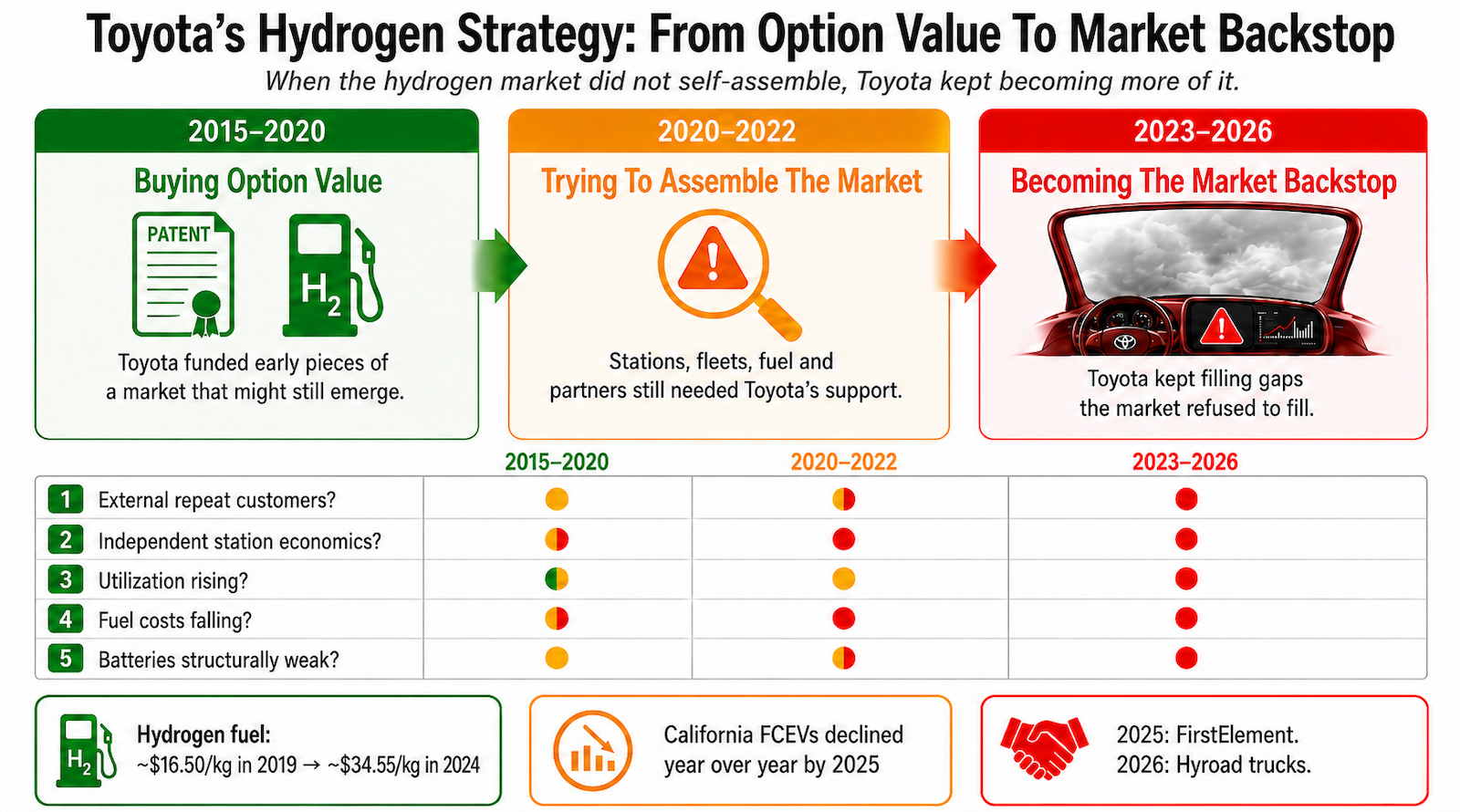
Summary By: eMotoXToyota’s persistent commitment to hydrogen fuel-cell technology remains notable despite the broader market’s reluctance to embrace it. The company’s latest move involves deploying 40 Class 8 hydrogen trucks in Southern California through a partnership with Hyroad, a firm formed from former Nikola executives and assets. While the order is modest in scale, it highlights Toyota’s continued involvement not only as a vehicle supplier but also as an infrastructure developer and fuel provider, effectively orchestrating a controlled ecosystem rather than responding to organic market demand.
This pattern of Toyota’s engagement extends beyond the latest truck deployment. The automaker frequently appears behind various hydrogen initiatives worldwide, from bus manufacturers in Portugal to fuel-cell projects in California and collaborations with other vehicle makers. These efforts reflect Toyota’s long-term strategic bet on hydrogen, rooted in its engineering heritage and Japan’s industrial policies supporting the technology. However, the company’s approach has increasingly relied on substantial corporate support and subsidies, as genuine market forces have yet to produce sustainable growth or independent customer uptake.
Toyota’s early enthusiasm for hydrogen fuel cells was justifiable when uncertainty was high and the technology’s potential was still being evaluated. Yet, by the late 2010s, economic and environmental analyses began to reveal significant drawbacks compared to battery-electric vehicles. Hydrogen’s high fuel costs, limited infrastructure, and energy inefficiencies have consistently hindered its competitiveness, particularly in passenger cars. California’s hydrogen refuelling prices, often double or more than the parity needed with gasoline, have made fuel-cell vehicles like the Mirai uneconomical for most consumers, a challenge that has only intensified in recent years.
Around 2020, Toyota faced a strategic crossroads as the hydrogen market failed to gain traction despite years of investment. The company shifted focus from consumer vehicles to more controlled applications such as buses, logistics fleets, and port operations, where hydrogen’s advantages might be more pronounced. Nevertheless, even in these niches, battery-electric alternatives have advanced rapidly, and the fundamental issues of cost, infrastructure, and demand remain unresolved. California’s experience, with declining fuel-cell vehicle numbers and struggling refuelling stations, serves as a critical indicator of the technology’s ongoing struggles to establish a self-sustaining market.
Looking ahead, Toyota’s continued hydrogen ventures underscore the tension between long-term industrial bets and market realities. While the company’s engineering prowess and strategic patience allow it to maintain a foothold in hydrogen, the broader transport sector is increasingly dominated by battery-electric solutions. For hydrogen to move beyond niche applications, it will need to overcome significant economic and infrastructural hurdles, demonstrating clear advantages where batteries fall short. Until then, Toyota’s hydrogen ambitions may remain a carefully managed experiment rather than a market-driven success story.