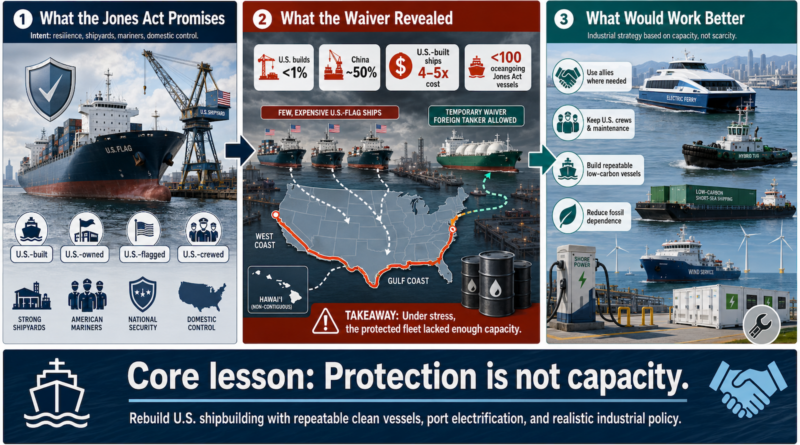
Summary By: eMotoXThe recent waiver of the Jones Act by the Trump administration has highlighted significant shortcomings in the United States’ domestic shipbuilding and maritime logistics capabilities. Although the waiver was a limited, temporary measure allowing foreign vessels to carry certain cargoes between U.S. ports, it exposed the inability of the protected American fleet to meet demand efficiently and cost-effectively. This move, intended to ease logistical pressures particularly in fossil fuel transport, underscores the gap between the law’s protective intentions and the practical realities of the U.S. maritime industry.
The Jones Act mandates that cargo transported between U.S. ports must be carried on vessels that are built, owned, flagged, and crewed domestically, aiming to preserve national security, shipbuilding capacity, and maritime expertise. However, the law’s protection has not translated into a competitive or sufficiently large commercial shipbuilding sector. While countries like China, South Korea, and Japan dominate global shipbuilding, the U.S. produces less than 1% of commercial vessels worldwide, with domestic ships costing several times more than their Asian counterparts. This disparity has resulted in a small, specialised, and expensive Jones Act fleet that struggles to meet all domestic shipping needs.
The waiver did not represent a repeal or broad liberalisation of the Jones Act but rather a narrowly tailored exception during a period of logistical stress. Despite its limited scope, the waiver revealed latent demand for maritime transport on routes underserved by the domestic fleet, particularly for fuel shipments from the Gulf Coast to the West Coast. Data showed a significant increase in waterborne fuel movements during the waiver period, demonstrating that the existing system imposes capacity constraints that become apparent when demand or geographic factors intensify.
Hawaii’s reliance on maritime supply chains offers a stark example of the practical challenges posed by the current system. With no alternative transport modes linking it to the mainland, the state depends almost entirely on shipping for essential goods and fuel. Lawmakers like Representative Ed Case have emphasised the limited number of Jones Act-compliant vessels, particularly oil tankers, highlighting the vulnerability of supply chains under the current fleet size and composition. The waiver thus serves as a cautionary illustration that legal protection alone cannot guarantee resilience or efficiency in U.S. maritime logistics.
Looking ahead, the waiver’s implications suggest that policymakers must confront the broader issues of industrial competitiveness, fleet modernisation, and infrastructure investment rather than relying solely on protectionist legislation. While the Jones Act remains a cornerstone of U.S. maritime policy, its limitations call for a more comprehensive strategy to rebuild domestic shipbuilding capacity and ensure reliable, cost-effective shipping services. The debate sparked by the waiver may prompt renewed efforts to align national security goals with economic realities in the maritime sector.