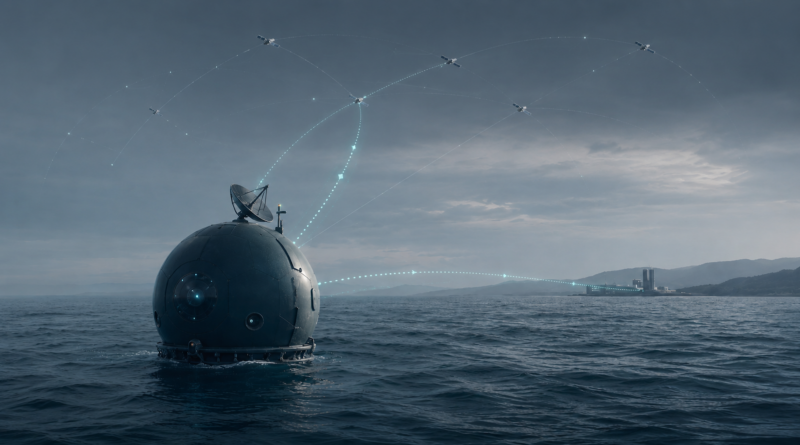
Summary By: eMotoXPanthalassa, a company backed by a $140 million investment round led by Peter Thiel, is pursuing an ambitious project to harness ocean wave energy for powering offshore AI data centres. The concept involves placing autonomous floating platforms in the open ocean that convert wave motion into electricity, which is then used directly to run AI inference workloads. By transmitting computational results via satellite, the company aims to bypass traditional constraints such as grid connections, land availability, and lengthy interconnection delays, presenting a novel approach to the growing challenge of securing sufficient power for AI operations.
The company’s origins lie in wave energy technology rather than data centres, having developed several prototypes like Ocean-1 and Ocean-2 to capture wave power through overtopping devices. Panthalassa’s strategic pivot to integrating AI compute on these floating platforms represents a significant shift from attempting to export electricity to shore towards creating a self-contained energy and compute system at sea. This reframing addresses some commercial challenges but does not eliminate the fundamental difficulties associated with wave energy, including harsh marine conditions, maintenance complexity, and economic viability.
Wave energy has long been regarded as a promising but elusive renewable resource, with decades of development hindered by the ocean’s unforgiving environment and high operational costs. Previous high-profile projects, such as Scotland’s Pelamis and Aquamarine Power’s Oyster, ultimately failed to achieve commercial success despite promising prototypes. Panthalassa faces the same core challenges of survivability, reliability, and cost-effectiveness, compounded by the additional complexities of integrating high-density AI computing and satellite communications on floating platforms.
The project’s ambition lies in combining multiple advanced technologies—wave energy conversion, offshore engineering, autonomous stationkeeping, corrosion and biofouling management, cooling systems, and satellite networking—into a single operational stack. Each element carries its own risks and reference points, and stacking them increases overall complexity and uncertainty. While the concept is compelling in theory, it remains to be seen whether Panthalassa can overcome the substantial technical and operational hurdles to create a viable wave-powered AI compute infrastructure.
Ultimately, Panthalassa’s approach highlights the tension between visionary innovation and the practical realities of marine energy systems. The company’s effort to sidestep traditional grid limitations by placing compute offshore is bold, but the ocean’s harsh conditions and the history of wave energy development suggest a challenging road ahead. Success would require not only technological breakthroughs but also robust solutions to maintenance, safety, and economic sustainability in one of the most demanding environments on Earth.