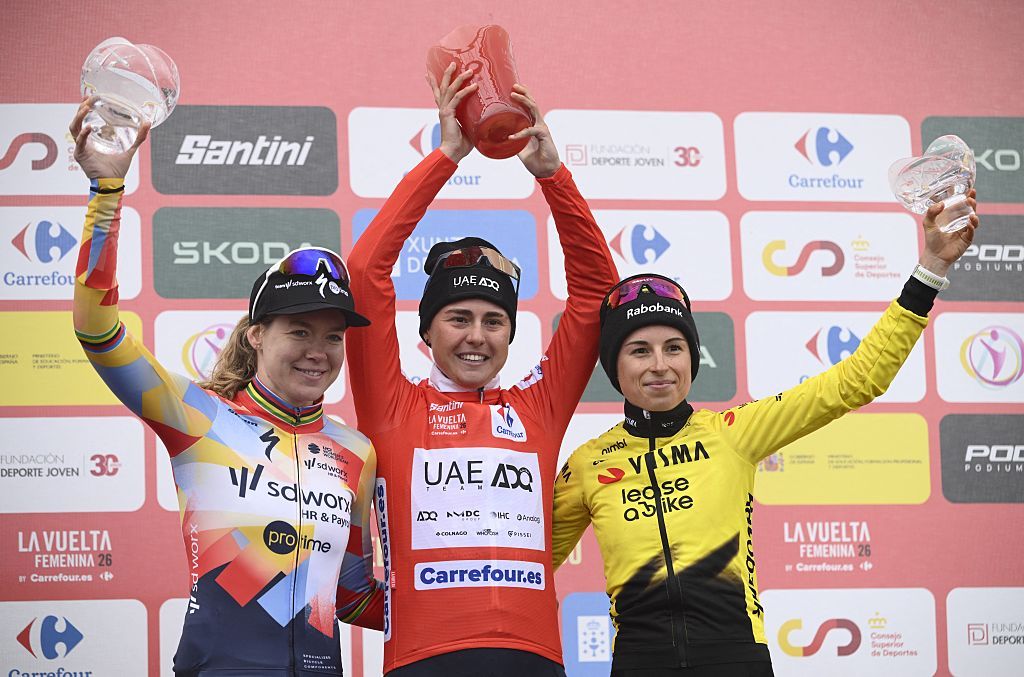
Summary By: eMotoXThe 2026 edition of La Vuelta Femenina marked a significant moment in women’s cycling, as a fresh wave of young talent emerged to challenge the established hierarchy. Paula Blasi of UAE Team ADQ made history as the first Spanish rider to win the race, showcasing her rapid ascent in the sport following a breakthrough victory at the Amstel Gold Race. Alongside Blasi, several riders aged between 20 and 25 demonstrated their ability to compete at the highest level, signalling a generational shift within the peloton. Notable performances included stage wins and consistent showings from riders such as Cédrine Kerbaol, Noemi Rüegg, Shari Bossuyt, and Marion Bunel, highlighting the depth of emerging talent.
Franziska Koch of FDJ United-Suez epitomised this new generation’s versatility and ambition. After a standout spring season capped by a Paris-Roubaix victory, Koch entered the Vuelta with heightened expectations and delivered a strong, aggressive campaign. She wore the leader’s red jersey for several stages and fiercely contested the points classification, ultimately finishing just behind Lotte Kopecky in the green jersey competition. Koch’s ability to perform consistently across varied terrain and stages underscored her status as a key figure in the evolving landscape of women’s road racing.
Despite the rise of new contenders, SD Worx-Protime maintained their reputation as one of the sport’s most formidable teams. Although no longer as overwhelmingly dominant as in previous years, the squad continued to secure crucial stage victories and podium finishes, with Anna van der Breggen’s second place overall exemplifying their enduring strength. The team has undergone significant changes recently, losing several star riders and experiencing retirements, yet they remain a central force in the Women’s WorldTour, adapting to a more competitive environment while still influencing race dynamics.
The race was also marked by aggressive tactics and unfortunate crashes, which affected key riders and shaped the overall outcome. Marianne Vos’s crash, for instance, shifted sprint leadership within Visma-Lease a Bike to Sarah Van Dam, who proved her capability in reduced sprints. The final stages, particularly the challenging climbs of Les Praeres and L’Angliru, proved decisive in separating the contenders and confirming the new generation’s rise. The conclusion of the race also symbolised a passing of the torch, with veteran Mavi García retiring and Blasi poised to carry forward Spanish women’s cycling on the world stage.
Looking ahead, the results of La Vuelta Femenina 2026 suggest a more open and dynamic era in women’s cycling, where youthful exuberance and emerging stars will increasingly challenge established champions and teams. The blend of experienced squads like SD Worx-Protime with ambitious young riders promises exciting competition in future races. As these talents continue to develop, the sport is set to benefit from heightened intensity, tactical innovation, and a broader international appeal.