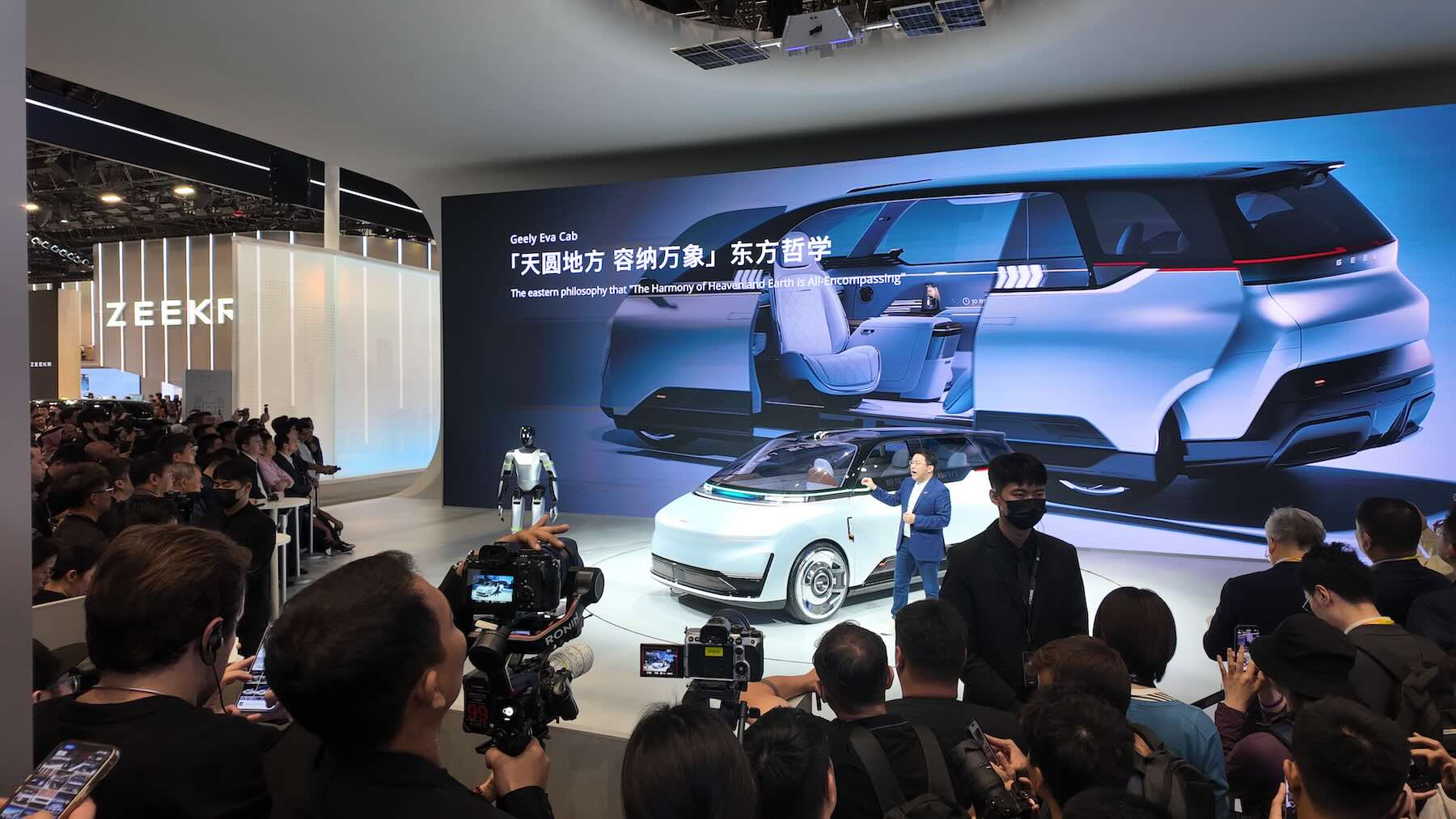
Summary By: eMotoXGeely has unveiled the EVA Cab, a purpose-built electric robotaxi prototype, at the Auto China 2026 show in Beijing, marking a significant step in China’s autonomous and electric mobility ambitions. Developed in collaboration with AFARI Technology and CaoCao Mobility, Geely’s ride-hailing subsidiary, the EVA Cab is designed to showcase the company’s “Full-Domain AI 2.0” framework. This integrates autonomous driving hardware, in-car computing, vehicle-cloud security, and software systems, signalling a move towards what Geely terms “embodied intelligence” in new energy mobility.
The EVA Cab’s design is tailored specifically for robotaxi use, featuring wide-opening electric sliding doors and a face-to-face cabin layout to maximise interior space and comfort. Geely has emphasised a futuristic, lounge-like interior, with distinctive elements such as a “Galaxy Skyroof” and artistic door panels. On the technology front, the vehicle boasts several industry firsts, including a “Quantum-Level AI Electronic and Electrical Architecture,” a high-resolution 2160-line digital LiDAR system, and a mass-production-ready Level 4 autonomous driving software solution. The electrical architecture uses quantum encryption to enhance vehicle-to-cloud security and includes diagnostic systems to monitor the vehicle throughout its lifecycle.
Under the bonnet, the EVA Cab is powered by three flagship chips—NVIDIA SuperChip, NVIDIA Thor U, and Qualcomm Snapdragon 8397—delivering over 3,000 trillion operations per second (TOPS) to support complex autonomous driving tasks. The digital LiDAR system offers a detection range of up to 600 metres, enabling the vehicle to navigate challenging driving scenarios. Geely’s AFARI G-ASD L4 software aims to facilitate fully unmanned shuttle services on public roads, although the company acknowledges the challenges inherent in deploying robotaxis at scale. Geely has already conducted pilot operations in Hangzhou and Suzhou and plans to launch a customised EVA Cab for CaoCao Mobility in 2027, signalling a clear path towards commercial robotaxi services.
Beyond the EVA Cab itself, Geely is positioning itself as an intelligent mobility technology company rather than a traditional automaker. Since 2021, it has been developing foundational AI models and established the Xingrui Intelligent Computing Center, which now boasts 23.5 EFLOPS of computing power, reportedly the highest among Chinese automakers. Its latest AI initiative, the World Behaviour Model (WAM), integrates vehicle systems such as the cockpit, driver assistance, chassis, powertrain, and body control into a coordinated software architecture. This holistic approach aims to enhance energy management, safety, and user experience in future electric vehicles, reflecting the evolving priorities in EV development.
While the EVA Cab’s immediate impact outside China may be limited, the technologies it embodies—such as high-voltage EV architecture, ultra-fast charging, and advanced AI integration—highlight broader trends shaping the future of electric and autonomous mobility. Geely’s efforts underscore the increasing importance of software, cybersecurity,