EV news article header featuring electric vehicle news, EV charging station, electric car updates and industry insights

News Menu

bicycle news feed and industry updates for eBike and cycling news
Click for Bicycle News
latest eBike news aggregator covering electric bike updates, reviews and industry trends
Click for eBike News
electric motocross news feed with latest dirt bike updates, reviews and industry insights
Click for eMotocross News
latest eScooter news aggregator featuring electric scooter news feed, updates, reviews and industry trends
Click for eScooter news
Article By:
CleanTechnica
2026-04-24 03:48:52

Driving A Car On HVO Is 79% More Expensive Than An Electric Car — New Analysis

Summary By: eMotoX
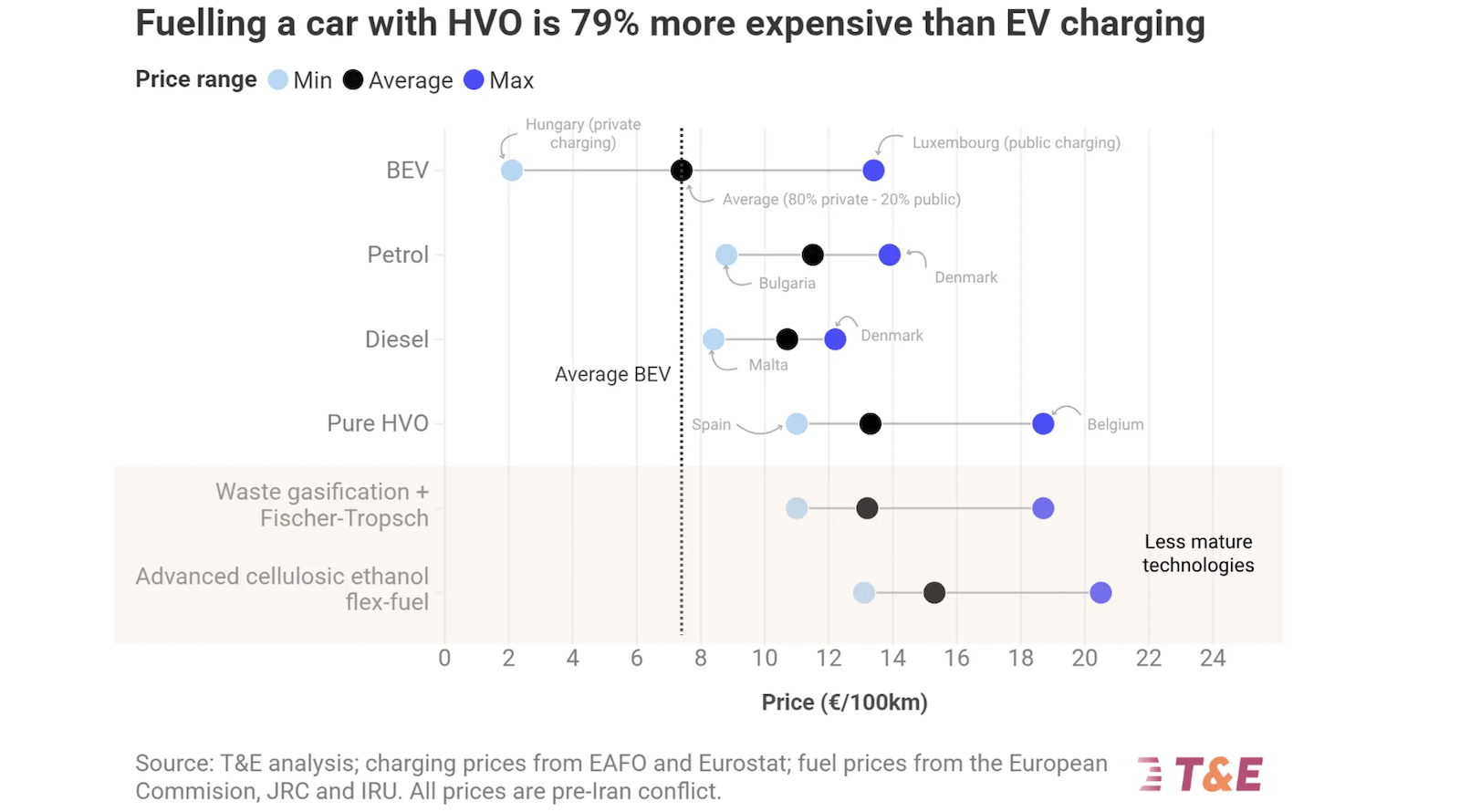
New research from Transport & Environment (T&E) reveals that driving a car powered by hydrotreated vegetable oil (HVO), a widely promoted advanced biofuel, is significantly more expensive than using electricity to charge a battery electric vehicle (BEV). On average, covering 100 kilometres in a car running on pure HVO costs €13, compared to just €7 for charging an electric car across the European Union. This analysis challenges the fuel industry’s narrative that biofuels offer an affordable alternative to fossil fuels, especially during the ongoing energy crisis. The findings come amid pressure from the German and Italian governments and the European automotive industry to relax EU CO2 emissions targets by allowing combustion vehicles running on advanced biofuels to be classified as zero-emission. T&E warns that such a move would not only undermine the push towards electrification but also force motorists to bear the burden of higher fuel costs due to the limited availability and high price of HVO. Less developed biofuel technologies, derived from sources like municipal solid waste or cellulosic residues, could be even more expensive, costing up to 110% more than driving a BEV. Émilie Casteignau Bernardini, vehicles policy manager at T&E, emphasised that promoting biofuels over electric vehicles risks delaying the transition to cleaner transport while increasing costs for drivers. She highlighted that maintaining stringent EU CO2 targets is crucial to ensuring the continued growth of affordable EV options and avoiding costly investments in biofuels that are neither scalable nor sustainable. The competition for limited advanced biofuels is expected to intensify, especially with the aviation sector seeking supplies to meet the EU’s ReFuelEU mandate, which imposes heavy penalties on jet fuel suppliers failing to use sustainable fuels. The European Commission’s proposal to grant biofuel credits to carmakers could exacerbate the problem, potentially increasing fuel expenditure by 60% by 2050 compared to current regulations. T&E estimates that this would translate into an additional €500 billion in fuel costs for European motorists over the next 25 years. Rejecting these biofuel credits, the organisation argues, would help lower costs for drivers, accelerate the shift to electric mobility, and reduce Europe’s dependence on imported fossil fuels and questionable biofuel feedstocks. Electric vehicles already provide a buffer against rising petrol prices, which have surged past $100 per barrel of oil. Earlier analyses by T&E demonstrate that the extra cost of fuelling a petrol car is expected to be five times greater than the additional expense of charging an EV. This economic advantage, coupled with environmental benefits, positions electric vehicles as the more sustainable and cost-effective choice for European drivers moving forward.