EV news article header featuring electric vehicle news, EV charging station, electric car updates and industry insights

News Menu

bicycle news feed and industry updates for eBike and cycling news
Click for Bicycle News
latest eBike news aggregator covering electric bike updates, reviews and industry trends
Click for eBike News
electric motocross news feed with latest dirt bike updates, reviews and industry insights
Click for eMotocross News
latest eScooter news aggregator featuring electric scooter news feed, updates, reviews and industry trends
Click for eScooter news
Article By:
CleanTechnica
2026-04-11 00:54:25

Natural Hydrogen Is Real, Commercialization Is Not

Summary By: eMotoX
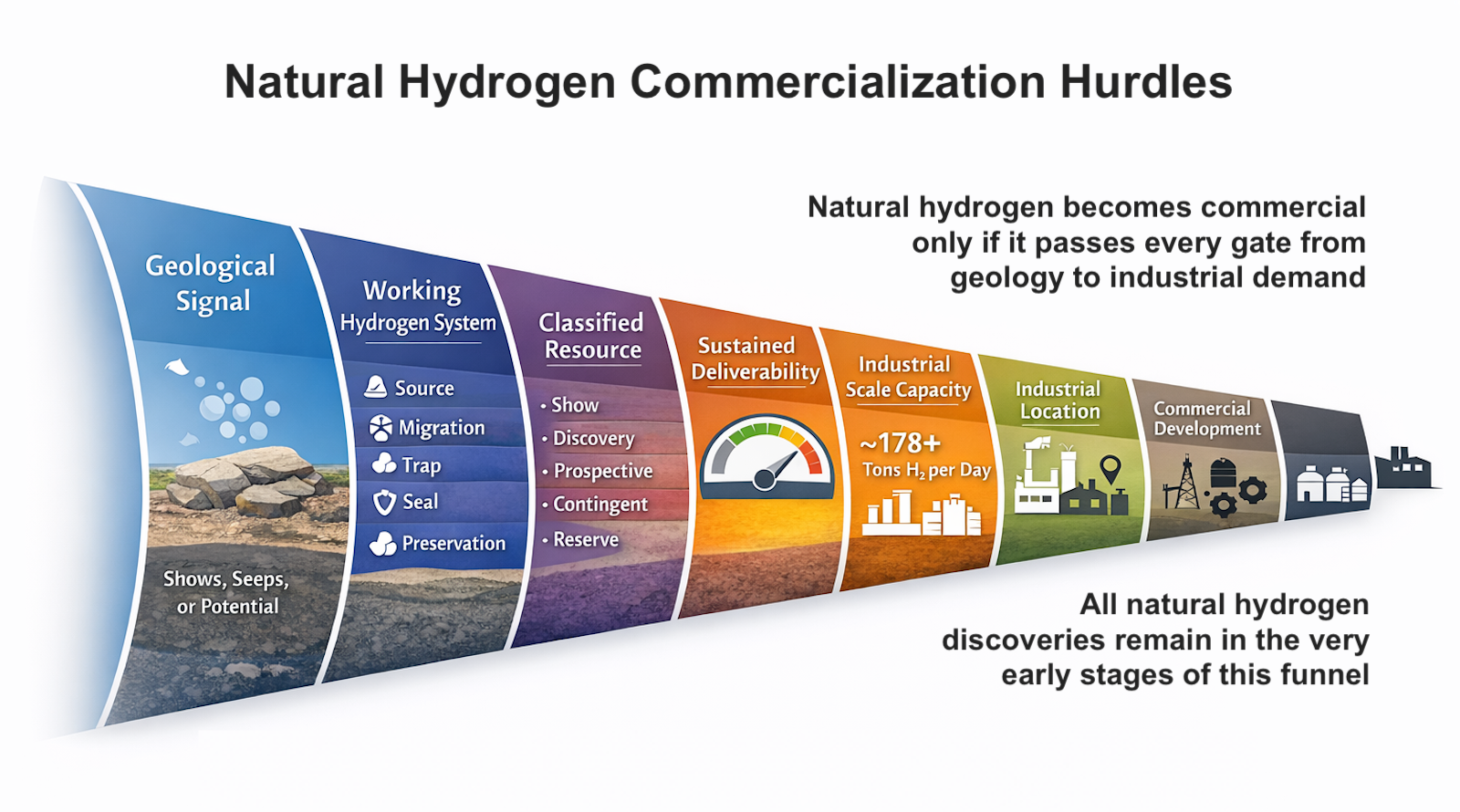
Natural hydrogen, long hailed as a potential game-changer in clean energy, remains a geological reality but has yet to evolve into a commercially viable resource. While the presence of hydrogen generated through natural geological processes such as serpentinization and radiolysis is now well established, the critical challenge lies in finding sufficient quantities that can be extracted sustainably and economically. Unlike hydrocarbons, hydrogen’s physical and chemical properties—its small size, high reactivity, and tendency to escape or be consumed by microbes—make it difficult to trap and preserve in reservoirs, complicating efforts to develop a reliable industrial supply. The industry has moved beyond early speculative optimism and is adopting a more rigorous, oil and gas-style approach to resource classification and appraisal. Current projects are assessed through stringent criteria including geological credibility, production scale aligned with industrial demand, and proximity to existing hydrogen consumers such as ammonia plants or refineries. Despite some progress, most natural hydrogen ventures remain at the prospect or prospective resource stage, with very few advancing to appraised reserves or commercial production. This cautious shift marks the sector’s transition from hype to disciplined exploration, but it also underscores the significant gap between geological potential and market-ready assets. Global hydrogen demand today stands at around 100 million tonnes annually, with projections suggesting a possible decline to below 50 million tonnes by the end of the century due to shifts in refining and industrial processes. Against this backdrop, the estimated output from all known natural hydrogen discoveries—approximately 2.5 million tonnes per year at best—is modest, representing only a small fraction of current and future demand. The majority of this potential comes from a single French site, which itself has a low probability of commercial success. Consequently, natural hydrogen is unlikely to displace a significant share of the hydrogen market or emerge as a major new energy source in the near term. The most tangible example of natural hydrogen utilisation is the Bourakébougou field in Mali, which remains the only site producing hydrogen for local use. Despite multiple drilling campaigns confirming high hydrogen concentrations, the field’s reserves and long-term commercial viability have yet to be fully demonstrated. This case highlights both the promise and the challenges of natural hydrogen extraction: while it proves the concept, scaling such operations to meet industrial demand remains a formidable task. The sector’s future will depend on continued exploration, rigorous appraisal, and the development of viable commercial models that can bridge the gap between geology and market realities.