
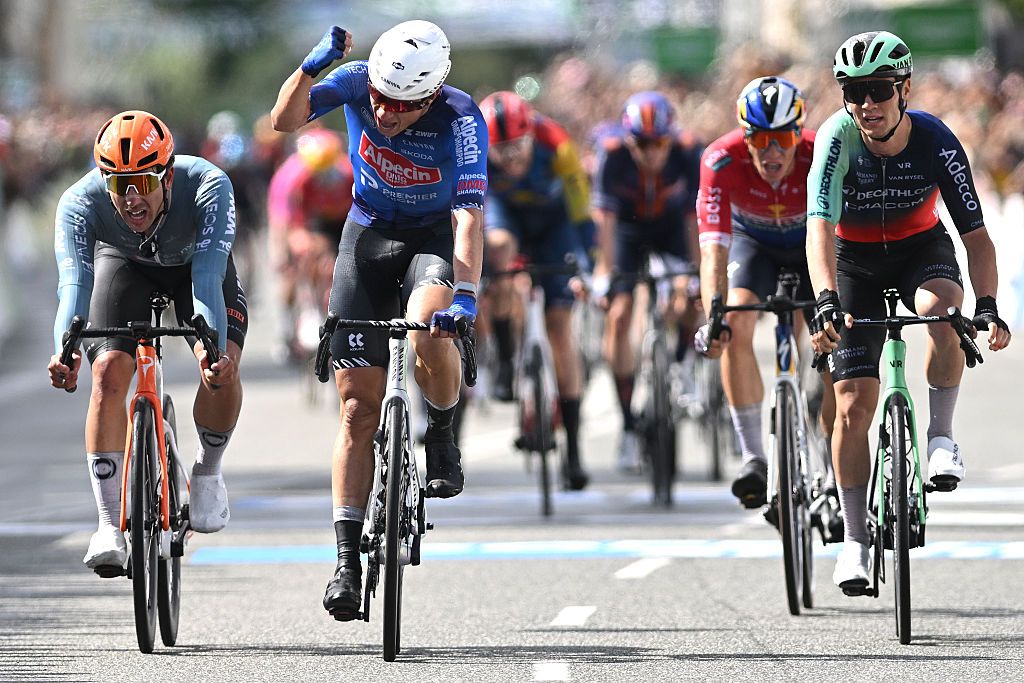
Copenhagen Sprint: Breakaway caught on the line as Jasper Philipsen avoids crashes and chaos to claim sprint victory
Jasper Philipsen secured a hard-fought victory at the second Copenhagen Sprint, a race marked by multiple crashes and a dramatic finale. The Belgian sprinter managed to avoid the chaos that fractured the peloton on the final circuit, relying on strong team support to maintain his position. After a breakaway group was caught just metres from the finish, Philipsen launched his sprint in the closing 150 metres, overtaking Tobias Lund Andresen to claim the win, with Sam Welsford completing the podium in third. The race unfolded over a pan-flat 228km route from Roskilde, concluding with multiple laps of a 10.2km city circuit in Copenhagen. Early on, a breakaway of five riders, including Anders Foldager and Rune Herregodts, established a lead and held it for much of the race. However, a crash 18km from the finish disrupted the peloton, splitting it and leaving several sprinters caught behind. This incident significantly influenced the race dynamics, allowing the breakaway to maintain a slim advantage until the final moments. Philipsen reflected on the challenge of returning to competition after several months off, noting the high speeds and constant accelerations on the technical city course. He expressed relief at avoiding the crash and praised the collective effort of the teams in reeling in the breakaway. Despite the chaotic finale, Philipsen emphasised the importance of the WorldTour victory for his confidence ahead of the Tour de France, where he aims to build on this form. The Copenhagen Sprint continues to attract top sprinters, with last year’s champion Jordi Meeus among the notable names who faced stiff competition this time around. Weather conditions, including intermittent light rain, contributed to slippery roads and early crashes, impacting riders such as Arnaud De Lie and Sam Bennett, the latter forced to abandon. The race highlighted the challenges of city-centre circuits, where tight corners and high speeds can provoke crashes that shape the outcome. Looking ahead, Philipsen’s triumph at Copenhagen sets a positive tone for the remainder of the season, particularly as he prepares for the Tour de France. The event itself, now in its second year, has established itself as a fast, intense sprint competition that tests riders’ positioning and resilience amid unpredictable conditions. The dramatic finale and close finish underline the unpredictable nature of urban sprint races and the fine margins that separate victory from defeat.
This summary was generated by AI. The full article is published on CyclingNews.