
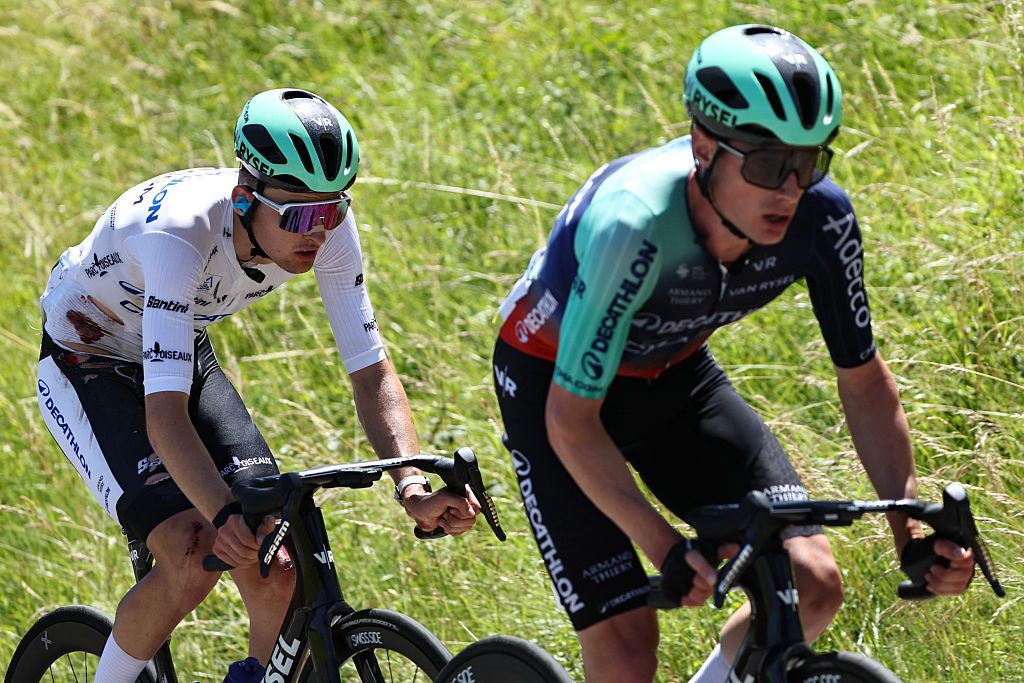
‘A shame for sporting fairness’ – Paul Seixas’ teammate questions other teams’ motives, rivals respond
Paul Seixas faced a challenging day at the Tour Auvergne-Rhône-Alpes after a crash left him trailing by four minutes, a deficit he managed to claw back with the help of his Decathlon CMA CGM teammate Léo Bisiaux. While Seixas accepted full responsibility for his misfortune and expressed no grievances, Bisiaux voiced concerns about the conduct of rival teams during the stage. The French rider suggested that other teams, who had previously been passive, suddenly became aggressive in their pursuit once Seixas was known to be disadvantaged, describing the situation as “a shame for sporting fairness.” Bisiaux’s comments appeared to reflect a sense of frustration with the dynamics of the race, where rival teams such as Visma-Lease a Bike, UAE Team Emirates, and Lidl-Trek were reported to be particularly active at the front of the peloton. He highlighted the contrast between the previous day, when no team seemed willing to chase a breakaway, and Saturday’s stage, where everyone appeared eager to contest the win. His remarks implied that some teams may have exploited Seixas’ crash to push the pace, thereby complicating his efforts to rejoin the race leaders. Responses from rival riders and team representatives challenged Bisiaux’s insinuations. Luke Tuckwell, wearing the yellow jersey for Red Bull-Bora-Hansgrohe, said he was unaware of Seixas’ crash until well into the stage and explained that his team’s strategy was focused on managing the breakaway rather than targeting any individual rider. Stage winner Isaac del Toro of UAE Team Emirates echoed this sentiment, noting that his team aimed to exert more control over the race after a lack of action the previous day. Tobias Halland Johanessen of Uno-X Mobility also praised Seixas’ strength in closing such a large gap, suggesting the race was simply competitive rather than unfair. From an editorial perspective, the situation highlights the complexities of race tactics and sportsmanship in professional cycling. While Bisiaux and his team may have felt aggrieved by the sudden shift in the peloton’s behaviour, the reality of racing means that teams will often capitalise on any opportunity to gain an advantage, especially when a rival suffers a setback through their own error. Seixas himself took full accountability for his crash and did not accuse others of wrongdoing, suggesting that the best response is to accept the challenge and use it as motivation rather than airing complaints publicly. The episode underscores the fine line between competitive strategy and perceived fairness in high-stakes racing.
This summary was generated by AI. The full article is published on CyclingNews.